Ryan Engels, Political Science Undergrad ’27
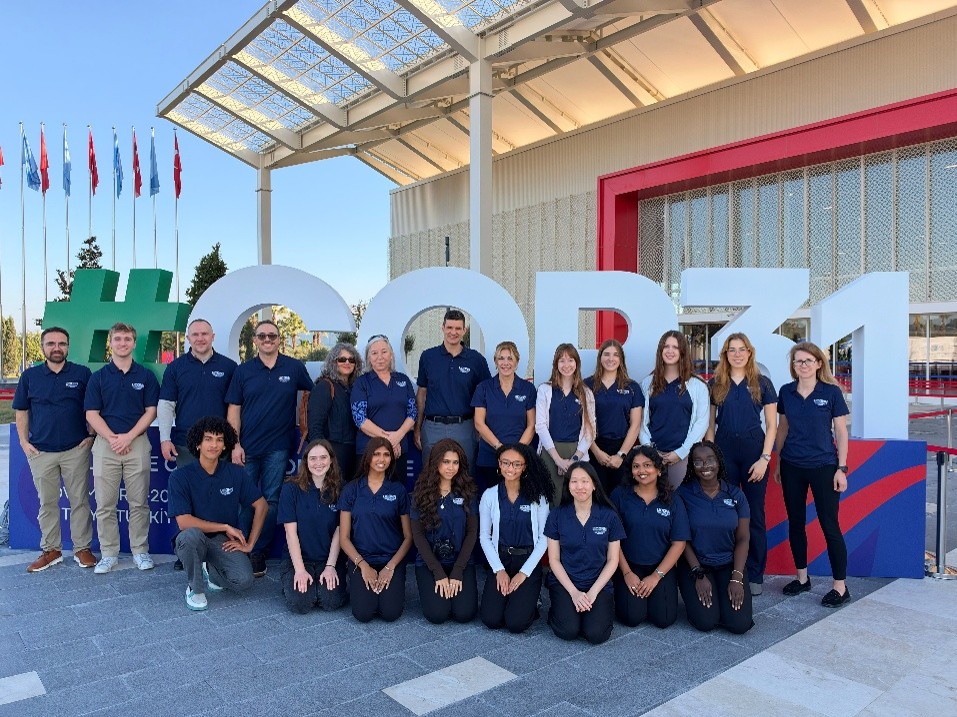
Just a few weeks ago, I was in Westbrook, Connecticut, chairing a meeting of my town’s Sustainability Committee. This week, I’m in Antalya, Turkey, attending the United Nations Climate Change Conference (COP31) as a UConn@COP Fellow. Safe to say, going from a local committee meeting to an international conference of stakeholders from nearly 200 countries, international agencies, and non-governmental organizations has been exhilarating but also overwhelming.
Frankly, I wasn’t sure what to expect once we arrived. At first, I was focused on a single goal: lying in bed after a grueling ten-hour flight across five time zones. Once acclimated, I was excited for the opportunity to engage with and learn from my fellow conferencegoers. During my first three days at COP31, I’ve had the chance to attend numerous talks on clean energy, climate resiliency, and, of course, data centers and artificial intelligence. I’m excited to share with you the lessons that I’ll bring back to my community. But first, I’d like to share my initial takeaway from my time in Antalya.
 As others may have noticed, there is a lack of representation from the U.S. federal government. Upon taking office in January 2025, the administration withdrew from all international organizations that it deemed to be contrary to the interests of the U.S. This included COP, which it described as a body that promotes radical climate policies. As someone working on environmental policy, I found this decision deeply disturbing, and the repercussions, which may not be felt immediately, will haunt us for years. The absence of the U.S. at COP31 is troubling and sends a message to the global community, whether we agree with it or not: the U.S. doesn’t care.
Fortunately, U.S. congressional, state, and local leaders have stepped in to fill the gap left by the absence of the federal government. Supported by advocacy organizations and coalitions, over 120 congressional, state, and local leaders attended COP31. This included Governors Gavin Newsom and Tim Walz, Representatives Maxine Dexter and Jared Huffman, and Mayors Janet Cowell and Joe Ganim. I was pleasantly surprised to see these leaders step up. I had a chance to see many of them speak and was inspired by their dedication to securing a brighter future for their communities.
However, this status quo is unsustainable. U.S. environmental policy and the fate of our communities should not ebb and flow with partisan winds. Threats such as extreme weather, human displacement, food and water insecurity, and disease are here. They don’t care about what you look like, who you pray to, where you live, or who you vote for. They aren’t going away unless we act. But the world cannot win this fight without the U.S.
So, my first takeaway? The U.S. needs to take the lead on protecting the environment. But to do so, we must change the narrative around it. Make it material, not moral; connect it to people’s livelihoods; and speak like a human. As I’ve seen at COP, the science and policy are there, but the narrative isn’t. Without it, we will continue to lose this issue to partisanship and leave our future in the hands of whoever sits in the Oval Office.