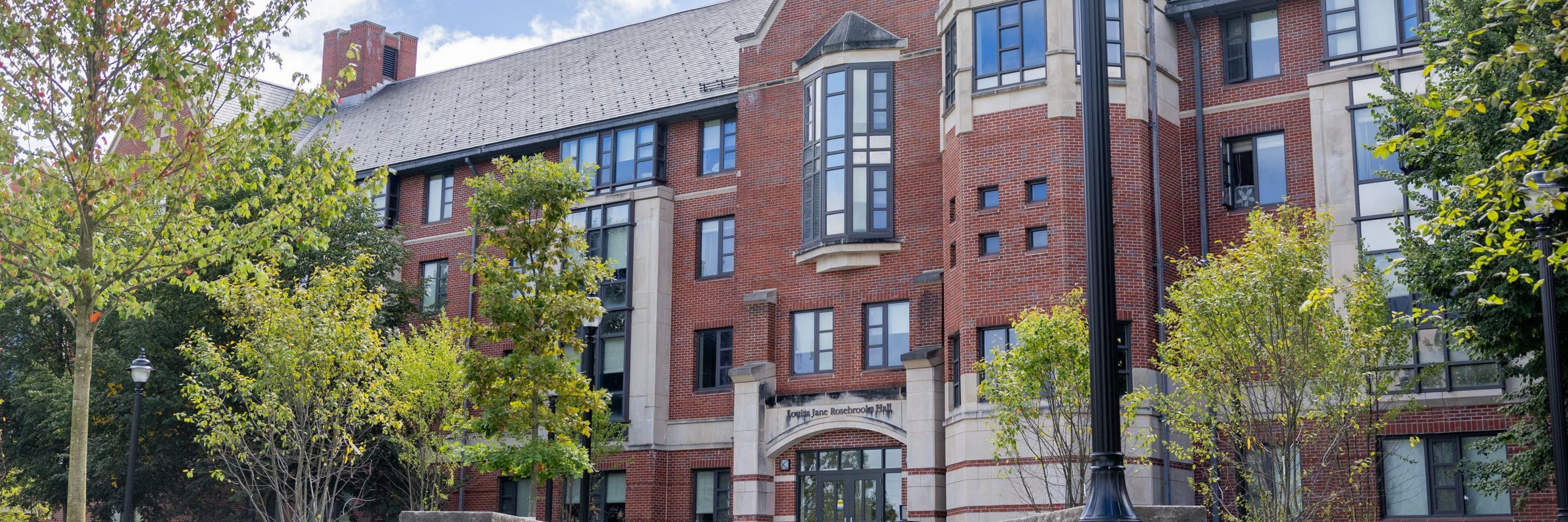
The Louisa J. Rosebrooks Residence Hall sits on a sunny day in Storrs on Aug. 20, 2024. (Sydney Herdle/UConn Photo)

Belimo Climate Foundation UConn Collaboration Project

About the Collaboration

As part of UConn's sustainability goals, outlined in the 2024-2034 Strategic Plan and Sustainability Action Plan, of carbon neutral campuses by 2030 and a longer-term goal of zero carbon by 2040, the Belimo Climate Foundation (BCF) and UConn have collaborated to evaluate possible energy efficiency improvements at the South Campus Residence Buildings (Wilson, Rosebrooks, and Snow Halls & Rome Dining Hall). After the completion of a comprehensive ASHRAE Level II energy audit, BCF has awarded UConn with a $1M grant to implement the recommended energy conservation measures (ECMs).

The quad between Connecticut Hall and the South Campus residence halls sits on a sunny day in Storrs (Sydney Herdle/UConn Photo)

The main objective of this project is to improve energy efficiency in the four South Campus Residence Buildings thereby reducing carbon emissions through targeted retrofit and renovation projects. The focus is on improving heating, ventilation and air-conditioning (HVAC) systems which account for a significant share of the buildings’ energy consumption. Building decarbonization is achieved by deploying modern building technologies, system controls as well as energy-efficient equipment. The final objective of this project is to share knowledge and best practices with the UConn community. This will encourage wider adoption of these types of building improvements as a climate solution and to foster student involvement to further their education related to building technologies to increase energy efficiency and reduce carbon emissions.

Wordmark logo for Belimo Climate FoundationAbout Belimo Climate Foundation

The Belimo Climate Foundation core mission is to accelerate the decarbonization of existing buildings while increasing public awareness of the significant role that building retrofits and modernization projects play in meeting global climate targets. BCF finances and supports building heating, ventilation and air conditioning (HVAC) technology improvements that lower the carbon footprint of nonprofit organizations' facilities focusing on optimizing and upgrading existing buildings. Its work emphasizes measurable emissions reductions, energy savings and long-term sustainability benefits.

BELIMO wordmark in black with orange accent lines

About Belimo USA

Belimo is the global market leader in the development, production and sales of field devices for the energy-efficient control of heating, ventilation and air-conditioning systems. The focus of our core business is on damper actuators, control valves, sensors and meters. Founded in 1975, the company has been listed on the Swiss Exchange (SIX) since 1995. Consistent focus on market and customer needs makes Belimo a partner which offers customers unsurpassed added value. The customer-oriented CESIM method developed by Belimo for optimizing building technology with sensors, control valves and damper actuators ensures that products have a major influence on comfort, energy consumption, safety, installation and maintenance in buildings.

UConn Team

The Belimo Collaboration project is supported by the following UConn organizations:

UConn Facilities Operations stacked wordmark logo

Energy Conservation Measures Implementation

UConn Foundation stacked wordmark logo

Fund Management and Community Outreach

UConn College of Engineering stacked wordmark logo

Student Involvement

UConn Office of Sustainability stacked wordmark logo

Community Outreach

ASHRAE Energy Audit & Energy Conservation Measures (ECMs)

The Belimo Climate Foundation funds building improvement projects related to mechanical HVAC systems. As noted in the ASHRAE audit report, ECMs to be funded by BCF include recommissioning, steam trap repairs, pipe and valve insulation, pressure independent control valve installations, kitchen hood exhaust controls, walk-in cooler/freezer controls and condensate recovery improvements. To further BCF and UConn decarbonization goals and initiatives, UConn will fund other recommended measures including building management system upgrades, lighting LED retrofits, clean energy technologies deployment as well as building envelop improvements.

ECM 1 - Lighting Fixture Retrofits

Replacement of existing fluorescent lighting fixtures with Bluetooth-enabled smart LED fixtures

Key Features:

  • Integrated controls for occupancy sensing, daylight harvesting, and more
  • Wireless capabilities for fixture grouping and zoning, remote monitoring, scheduling, etc.
  • Higher efficiency LEDs to reduce energy consumption

Anticipated Savings:

  • Electricity: about 795,000 kWh/yr & $69,000/year
  • CO2e Reduction: about 180 metric tons/year

Buildings Included:
Wilson
Rosebrooks
Snow
Rome

ECM 2 - Recommissioning (RCx)

A systematic process for evaluating, testing, and restoring building systems to optimal operational performance; identifies hidden inefficiencies in HVAC systems and low- or no-cost improvements that can significantly improve energy savings

Anticipated Savings:

  • Electricity: about 39,000 kWh/yr; ~$3,500/year
  • Thermal: about 40 MMBtu/year of steam & 104,000 ton-hrs/year of chilled water usage; ~$12,000/year
  • CO2e Reduction: about 60 metric tons/year

Buildings Included:
Wilson
Rosebrooks
Snow

ECM 3 - Steam Trap Replacement

A survey of the 22 steam traps in the distribution system to identify and replace failed traps, which can contribute to inefficiencies such as live steam loss and unnecessary fuel consumption at the central plant

Anticipated Savings:

  • Thermal: about 1,200 MMBtu/year of steam; ~$4,000/year
  • CO2e Reduction: about 85 metric tons/year

Buildings Included:
Wilson
Rosebrooks
Snow
Rome

ECM 4 - Pipe and Valve Insulation

Installation of hot water, steam, and condensate piping insulation to conserve energy and reduce thermal losses

Key Features:

  • Improves efficiency by reducing thermal losses to the environment
  • Protects personnel from hot surfaces
  • Extends the life of equipment like valves and fittings
  • Low-cost implementation with short payback periods

Anticipated Savings:

  • Thermal: about 2,000 MMBtu/year of steam; ~$6,400/year
  • CO2e Reduction: about 140 metric tons/year

Buildings Included:
Wilson
Rosebrooks
Snow
Rome

ECM 5 - Pressure Independent Valves

Installation of pressure independent control valves (PICVs) that integrate control and balancing functions to improve control and efficiency

Key Features:

  • Maintain a set flow rate regardless of changes in pressure across the system
  • Eliminate bypass losses and reduce pump energy
  • Zone-level modulation and flow control

Anticipated Savings:

  • Electricity: about 303,000 kWh/yr; ~$27,300/year
  • CO2e Reduction: about 90 metric tons/year

Buildings Included:
Wilson
Rosebrooks
Snow
Rome

ECM 6 - Kitchen Hood - Exhaust Fan Controls

Implementation of demand-controlled kitchen ventilation (DCKV) systems that use temperature/optical sensors to monitor cooking activity and appropriately adjust exhaust fan activity

Key Features:

  • Real-time airflow control based on the actual cooking load
  • Low fan energy consumption and reduced  heating/cooling loads
  • Integration of building automation systems

Anticipated Savings:

  • Electricity: about 74,000 kWh/yr; ~$4,700/year
  • Thermal: about 1,500 MMBtu/year of steam and 5,200 ton-hrs/year of chilled water; ~$5,000
  • CO2e Reduction: about 120 metric tons/year

Buildings Included:
Rome

ECM 7 - Rome Rooftop Photovoltaic Electric Generation

Installation of a roof-mounted 115 kW-DC solar photovoltaic (PV) system, estimated to offset about 20% of Rome's electric load

Key Features:

  • On-site renewable energy generation reduces energy use and utility bills
  • Excess generation can be exported to the grid for credit (net metering)

Anticipated Savings:

  • Electricity: about 145,000 kWh/yr; ~$13,000/year
  • CO2e Reduction: about 40 metric tons/year

Buildings Included:
Rome

ECM 8 - Walk-In Cooler/Freezer Controllers

Installation of walk-in cooler and freezer (WIC/WIF) controller systems to optimize the operation of refrigeration equipment based on real-time temperature and demand conditions

Key Features:

  • Intermittent fan control when cooling is not required
  • Optimized defrost cycles based on time or demand
  • Improvements to compressor efficiency
  • Remote monitoring capabilities

Anticipated Savings:

  • Electricity: about 39,500 kWh/yr; ~$3,600/year
  • CO2e Reduction: about 10 metric tons/year

Buildings Included:
Rome

ECM 9 - Condensate Recovery

Repair or replacement of failed underground condensate return piping to restore functionality and improve energy efficiency

Key Features:

  • Reduce loss of hot condensate and fuel consumption at the central plant
  • Eliminate additional water treatment and sewer disposal costs
  • Reduce risk of long-term water damage or freezing risk

Anticipated Savings:

  • Thermal: about 1,700 MMBtu/year of steam; ~$5,400/year
  • Water: about 15,000 gallons/year; ~$9,000/year
  • CO2e Reduction: about 110 metric tons/year

Buildings Included:
Wilson
Rosebrooks
Snow
Rome

ECM 11 - Building Envelope Improvements

Improvements to building envelope through targeted air sealing and weatherization (e.g., sealing joints, weatherstripping doors, caulking windows and building interfaces, etc.)

Key Features:

  • Reduces uncontrolled air infiltration and exfiltration
  • Lowers heating and cooling loads and enhances system performance
  • Improves draft, uneven temperatures, and moisture entry

Anticipated Savings:

  • Thermal: about 1,800 MMBtu/year of steam and 5,700 ton-hrs/year chilled water; ~$6,200/year
  • CO2e Reduction: about 120 metric tons/year

Buildings Included:
Wilson
Rosebrooks
Snow
Rome

ECM 12 - S Lot Canopy Photovoltaic Electric Generation

Installation of an 853.2 kW-DC solar photovoltaic (PV) carport array over the existing S Lot surface parking lot, including integrated LED lighting, snow guards, a weather station, and cloud-based data acquisition

Key Features:

  • Carport-mounted systems offer both clean energy production and covered parking
  • On-site generation reduces electricity usage and utility bills

Anticipated Savings:

  • Electricity: about 961,000 kWh/year; ~$86,500/year
  • CO2e Reduction: about 290 metric tons/year

Buildings Included:
Wilson
Rosebrooks
Snow
Rome

Project Updates & Insights

Project updates and insights will be added when they are available to keep everyone up to date as the project progresses.