UConn@COP

The UConn@COP Fellowship Program strives to build future leaders in climate science and policy and to promote UConn’s leadership on climate change and sustainability issues through four main pillars:

1) Student Engagement
2) Experiential Learning
3) Interdisciplinary Group Discussion
4) Cultural Immersion

Participating fellows are selected through a highly competitive application process that considers GPA, relative extracurricular involvement, and an essay that speaks to their interest in the program.

The following blog articles have been written by past and present UConn@COP fellows, faculty, and staff, as well as by students who have attended events recapping the UConn@COP experience on campus.

The Interwoven Fates of Climate Change and Health – Erik Choi

WHO panel discussionAttending COP27 has been the privilege of a lifetime. It is hard to put into words the sense of veneration that filled me when I found myself surrounded by politicians, activists, educators, and students all united by a genuine passion for climate justice. I came to the conference with the goal of learning how I could pursue a career in the healthcare sphere having gained a perspective on the environment’s role in human health. Like many others, I have always equated healthcare to medications, research innovations, and doctor visits. My experience at COP27 showed me how multidimensional health truly is, and emphasized how the climate crisis deteriorates it. Furthermore, I learned how the inequalities exacerbated by climate change are further amplified through health outcomes.

A particularly memorable panel I attended was hosted by the World Health Organization (WHO). Dr. Tolullah Oni, a physician-scientist and urban epidemiologist of the University of Cambridge, moderated a conversation between academics, leaders of philanthropic organizations, and medical students on the effects of energy, agriculture, and food systems on health in Africa. The conversation reaffirmed much of what I knew: the importance of a nutritious, whole-food based diet and the detrimental effects of pollution. But it also expanded my current views on how sophisticated the issue is. For example, I never considered how the permeation of processed, cheap, calorically dense foods from the West have wreaked havoc on indigenous food systems.

Listening to the panel was sobering. I couldn’t help but introspect on the chasm between the food systems in developed countries like the United States and developing countries around the world. The responsibility to close that gap is on the developed countries, who are responsible for the dissemination of a culture of consumerism that has poisoned systems around the world.

So how do we combat this issue?

From a policy perspective, the speakers emphasized time and time again the importance of context. Every country is in a different stage of their economic and social development. Whether it’s in transitioning to greener energy, establishing transportation infrastructure, or reforming food systems, the starting points of a country and the pathways through which a country travels to reach a sustainable future matter. Thus, policy and strategies should be tailored to an individual country’s needs to fully utilize resources and create perpetual change.

I asked myself what I could do as a student fascinated by health and inspired by the work of the public health experts in front of me. I had the chance to briefly speak with Dr. Oni before she rushed off to another meeting. I asked her how aspiring medical professionals can enter the field with a cognizance of the various environmental factors affecting health. Her response stuck with me and offered insight into how she ended up in the interdisciplinary position she is in now. She told me she had to learn to be comfortable with the uncomfortable. Interdisciplinary collaboration is difficult, especially in a field as broad as health, but it is necessary to see progress. Seeking educational opportunities in non-clinical areas, such as public health, can bridge the gap between the clinical and non-clinical sides of healthcare so that healthcare can be delivered in a more complete and holistic manner. While her advice was health-specific, I strongly believe in the sentiment of incorporating an interdisciplinary, environmental lens into research and policy, because everything is interlinked and affected by climate change.

Science and Policy: Multilateral Approaches to Addressing Ocean Acidification – Claire Lee

Claire Lee at Ocean COP27 pavilionAs a student pursuing a dual degree in Ecology and Evolutionary Biology and Political Science on the pre-law track, I came into this conference with great excitement to witness firsthand the collaborative bridging of knowledge that will facilitate climate solutions. Paired with my love for the ocean and the beauty of its vast biodiversity, my academic path in ecology has primed me for the discussions at COP27 surrounding the detrimental impact of climate change on marine life. I strongly believe that the combined efforts of scientific and legislative expertise are imperative in not only achieving the UN’s net zero goals but other important environmental issues as well.

Coral reefs are central to hosting thousands of important marine species that uphold our biosphere and providing a wide variety of crucial ecosystem services. Many serve as a pillar of income and benefit to the economy for nations that rely on these ecosystems for ecotourism. However, these reefs are especially under threat by ocean acidification, caused by anthropogenic activities like the agricultural industry and increased greenhouse gas emissions. Ocean acidification is a ubiquitous and burgeoning problem that plagues our world’s oceans, and efficient action is needed immediately to mitigate its impact and spread. The means in which we take action should be raised to our utmost consideration, therefore I strongly believe in the vast potential of taking on an interdisciplinary approach toward addressing ocean acidification and its impacts on coastal communities and ecosystems.

I had the privilege and opportunity to attend a panel discussion called “OA Action Plans: Increasing ambition for climate action & transforming planning and response to climate-ocean change” at the Ocean Pavilion during my first day at COP27. This event was composed of government leaders and organizations from around the world who have been committing their efforts to the protection of coastal communities, livelihoods, and species from ocean acidification and other climate-related issues. Three speakers stood out to me in particular: Ambassador Ilana Seid, the permanent representative to UN Palau, Dr. Arthur Tuda, the executive director of the Western Indian Ocean Marine Science Association, and Congressman Eduardo Murat from the General Congress of the United Mexican States.

Ambassador Seid discussed the significant strides being taken by researchers from Stanford University and the University of Hawaii within the collaborative space of science in the protection of marine biodiversity. One innovation that I found to be especially interesting was the development of ocean antacid tablets to mitigate the effects of ocean acidification and thus help prevent food shortages for reliant coastal communities and biological catastrophes. Dr. Tuda, another panelist from the scientific side of the conversation, highlighted the collective findings of a new report – a culmination of four years of monitoring across six countries – on ocean acidification in the western Indian Ocean region. The key takeaway of this report is the importance of regional collaboration between nations, scientists around the world, and the combined scientific knowledge and resources that facilitate humanity’s progress in understanding climate change. On the other side of the panel, Congressman Murat provided expertise through a legislative lens. Murat is seeking to collaborate with other legislators and eventually pass a bill on ocean acidification consisting of provisions that define the problem itself and gather programs to map, monitor, and manage blue carbon areas to strengthen future legislation in Mexico. Moreover, this bill seeks to reinforce legislation on the source of the problem, targeting agricultural and livestock runoff. After hearing both sides of the conversation, I wondered, how can we maintain a fair balance between different voices and disciplines in reaching solutions? This panel discussion further strengthened my desire to examine environmental issues through multiple lenses.

Moving forward, we must continue to press forward in our fight against climate change through the implementation and advancement of multilateral-based solutions. Although science and policy are seemingly very different realms of expertise, I was able to witness the vast potential for these fields to work in tandem to enact tangible change and solutions in a multi-layered crisis. It is imperative to step outside of our comfort zones and look for answers to our world’s most pressing environmental issues that stretch beyond our own boundaries of knowledge. With that in mind, I encourage all students of non-environmental majors and backgrounds to engage in opportunities like the COP fellowship, to not only engage with the real world but to also gain exposure to the diverse mindsets and perspectives that make up this conference. More than ever before, we need the integration of different disciplines, backgrounds, and ideas into our global negotiations and solutions.

Why Am I Here? – Dr. Mark Urban

Why am I here at the climate summit called COP 27 in Sharm el-Sheikh, Egypt? Why did I leave my family behind and travel halfway around the world? Why would I expend that CO2 from my flight, fully knowing its contributions to climate change?COP27 fellows

As an ecologist, I should be working on my backlog of academic papers that address how climate change affects biodiversity and ecosystems and how to mitigate those effects. In my field, these papers likely have a more direct effect on climate change versus my interaction with global colleagues at the COP.

I am here because I have come to believe that one of the most important actions I can take to reduce climate change is to provide the information and experiences to create the leaders of tomorrow who will solve this climate crisis.

We started the UConn@COP program by bringing our first set of undergraduate students to COP 21 in Paris.

COP21 Students

We were not officially badged at our first COP, but attended the extensive side events and public “Green Zone.” The feedback from students was clear – the trip had transformed their perspectives on climate change and empowered them to become leaders in their respective areas. Following Paris, we went to the Marrakech COP and received U.N. observer status by the Bonn COP, which provided a small number of passes to get into the official events. We have now been in Katowice and Madrid. We took students to Glasgow at the last minute and tested for Covid-19 every day. And now here we are in Egypt.

The trip is for the students, for sure, but I also come for the hope I find here. I gain hope as I see most of the world coming together to solve the climate crisis. The process is incremental and not nearly fast enough to prevent the onslaught of climate-induced disasters. However, I always find some hope somewhere between the negotiating rooms and the pavilions, on the long bus or train rides, and between sleep-deprived nights and our “breakfast club” conversations. I see hope in the diversity of people from around the world – all so different and yet also so much the same. I see hope in the small victories of words moved from bracketed provisional text to unobstructed official language. And above all else, I see hope in the students that fearlessly approach world leaders, bring their experiences back to their friends, university and communities, and continue on to careers as leasers at the forefront of climate action.

Is COP 27 worth the carbon dioxide spent? I won’t know unfortunately until many years into the future, when the students of today bring about the changes that finally solve the climate change crisis.

COP27: Does Science Set Long Term Goals of UNFCCC? – Dr Anji Seth

Sunset at COP27The pace of global warming is accelerating. Impacts are coming faster and more furiously.

Scientists around the world have stepped up to publish 6 new reports* in less than 5 years. Major new findings include that additions of CO2 are the direct cause of further heating and even small increments will continue to worsen impacts on human and ecosystem well-being.  The Science clearly states that a 1.5C temperature limit would result in the lowest impacts and related costs globally. The 2022 report on Mitigation makes clear that losses and damages being experienced already result from the cumulative emissions from large historical emitters.  So how is this new knowledge incorporated into the policy decisions being negotiated?

Like most processes within the UNFCCC, there is a formal review which can take a few years to complete. A review of the reports mentioned above has been ongoing for two years and is due to be completed at COP27. A strong statement from this review process, commensurate with the science, would demonstrate to the world the urgent need for transformational change across society.

As a climate scientist at my seventh COP, I was an observer in the room where it happened. I can share some insight into this particular negotiation.

A short draft “decision” document summarizes the latest science that will informs future UNFCCC policy negotiations, including Mitigation, Adaptation, and now Loss and Damage.

I am in the room on Thursday (Nov 16). Negotiators are meeting to finalize the document. They are apparently close. The draft “reaffirms the long term global goal” (from Paris: 2C and to pursue 1.5C), “expresses alarm and utmost concern that human activities have caused around 1.1C “ warming to date and “recalls that the impacts of climate change will be much lower” for 1.5C. This much is agreed upon.

But there is a tension in the room. Two statements in particular are in contention: (1)  the affirmation of 1.5C as the target “underscores urgent action is needed” to ensure peak emissions by 2025 with deep reductions by 2030; and (2) language related to Loss and Damage that details the responsibilities of developed countries given their disproportionate historical contribution to cumulative CO2 emissions.

The delegates are seated at tables arranged in a square. China, India, Saudi Arabia and Brazil are in one corner. The US, UK, Canada, Switzerland, and Japan are across the room. These two groups are taking opposing stands on the two issues.

Led by India, the First group wants to weaken the target to 2C, a step back from the consensus achieved in the Glasgow Pact last year at COP26.  And this group wants the strong language that would detail the responsibility of large historical emitters for Loss and damage. The second group led by the US states clearly that the 1.5 C affirmation must remain in the text, but will not accept the strong language that details developed country responsibility for Loss and Damage. The meeting is at an impasse.

There is talk of a ‘procedural’ conclusion that would nullify two years of work and agreement on many advances in the scientific basis for action. Or equally as bad, kicking the decision down the road to next year at COP28. A strong statement is needed to demonstrate to the world the need for urgent action to peak emissions by 2025.

No one wants a failure.

This meeting concludes with no agreement. The issues are referred to the COP Presidency for review.

At the sunset of COP27 there was a compromise, with both statements weakened. The mention of peak emissions by 2025 was removed (par 8). The language on equity, the role of historical emissions and the remaining carbon budget was also removed (par 20).

All sides can claim success, as the report is now complete with a consensus document that includes important new science.

But I must express alarm and utmost concern that Nature and science do not compromise.  Weakened language will not reduce the tragedies ahead. We can and must do better.


Anji Seth is a climate scientist, Professor, Head of the Department of Geography at the University of Connecticut, and co-director of the UConn@COP program – bringing a dozen students to the Conference of the Parties since COP21 in Paris.

Emtithat Mamhoud at COP26

by Sena Wazer

The first panel I attended at COP26 was focused on Climate Refugees. Honestly, it’s ironic when you consider that COP26 has a severe lack of focus on climate refugees included in the actual platform and agenda, even though more and more people are being displaced and will continue to be displaced moving forward. However, it was also one of the best panels that I attended during my time at COP26 because of a speaker named Emtithat Mamhoud. She is a Sudanese-American poet whose family fled from Sudan as refugees during the Darfur genocide, moving to the United States in 1998.

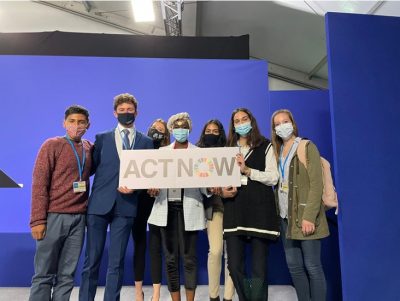
Several UConn Students and Climate Activist Emtithal Mahmoud hold up sign stating “Act Now”

She spoke about the need to listen to climate refugees and ensure that they are present and included in the spaces where decisions are made. She expressed frustration that resonated deeply with me regarding the lack of meaningful equitable climate action that generally comes out of these COP meetings. She shared a new poem, named, Di Baladna – Our Land in English – which starts off with the following quote:

“If you are reading this, I forgive you/You have grown far from the heart of me my child/have lost the familiar love we held for one another in your first years of life.”

Hearing her speak this poem gave me chills.

This experience was very powerful, and also very different from many of the events I attended. It was different because Mahmoud spoke from a personal perspective, being a refugee who has been affected by environmental issues herself. While many events – although certainly not all – felt impersonal, this one struck a deep chord with me and others in the room. It is indicative, I believe, of what effective environmental communication can do. Specifically, it helps one to understand a different perspective and more effectively convey an environmental issue in a way that feels personal and real. Through listening to people like Emtithat, I hope that bolder and more equitable climate action is possible. I believe it is, and if we are able to achieve this then I think COP could become a much more just and equitable place.

UConn@COP26

by Nidhi Nair

As a young girl growing up in a coastal state called Kerala in India, I was exposed to the devastating effects of climate change from an early age. Summers were sweltering, monsoons were ferocious and floods were frequent. In 2018, as I was packing up to move to the United States, my plans were delayed because of severe floods in Kerala caused by climate change, leading to the death of nearly 500 people in my state. I watched fearfully from my window as water filled my grandmother’s farm, and as roads became rivers in the deluge. This year, these trends have continued as nearly 22 people have died from flash floods and landslides caused by anomalous rainfall.

Nidhi Nair at COP26

Having grown up surrounded by the effects of climate change, I was motivated to understand and contribute to climate action, particularly climate finance, global data partnerships and R&D spending in climate research. As a student of economics, mathematics and statistics at the University of Connecticut, the opportunity to attend COP26 in Glasgow, Scotland this year was the perfect chance for me to combine these interests and learn more about the work done by a global coalition of environmental economists and policy makers.

COP26 started with a few space and timing issues, along with questions of inclusivity and representation. Many students, activists, researchers and policymakers from the Global South were not allowed to participate in the conference because of inequalities in vaccine access and cost considerations. I noticed that this led to clear differences in the number of observer passes handed out to delegates from developed countries like the United States compared to developing nations from across the globe.

Reasonably, this led to an air of despair and hopelessness among the young activists at COP26. After years of climate conferences after the seminal Paris conference, many of my fellow attendees seem to have given up on the prospect of multilateral discussions ever leading to fruitful outcomes. While this is an understandable reaction, I believe complete hopelessness about concerted climate action is impractical as there are many moving parts to global action, and compromise can only come through engaged discussion from multiple stakeholders. Beyond the global climate policy advancements made at Glasgow, the conference was a treasure trove of great ideas, conversations and discussions, and attending events hosted by scientists and grassroots organizations gave me hope for the future.

A summary of this week –

1. Events in the pavilion section of the conference included many researchers from around 70 different countries and organizations – and I tried to visit all of them! One of the best pavilion events I attended was in a section titled “All in for 1.5°” in which several small business owners with grassroots connections in six countries detailed their partnerships on climate finance. The global banks pavilion also held several interesting events throughout the week. It featured talks by representatives from the World Bank, Asian Infrastructure Development Bank, Climate Investment Funds, European Development Bank and many other financial and regulatory bodies. International development banks play a huge role in financing climate research in developing countries, where the impacts of climate change are the strongest.

2. I met Nancy Pelosi and other members of the American congressional delegation for an event titled “Gender Equity in Climate Action”. Various political leaders across the world discussed their country commitments, and I was disappointed by the symbolic and virtue signalling nature of their statements. Many representatives made empty promises to include gender based conditional requirements for the foreign aid they hand out for climate change. I thought this was inadequate and cumbersome as it handed the onus of responsibility to developing countries that are already battling the devastating consequences of climate change. On the plus side, Ecuador and Canada both discussed non-party stakeholder accountability from corporations which I saw as a positive sign.

3. An incredible event I attended was “Enhancing climate resilience for LDCs and SIDS through space data, finance mechanisms and partnerships” with speakers from Gambia, Scotland, Malawi, India and other countries. I was very impressed by the idea of a “data co-operative” to empower researchers to share their data with each other in ways that encourage innovative creation in least developed countries (LDCs) and small island developing states (SIDS). I was also inspired by Brazilian researchers who used space data to reduce indigenous vulnerabilities in the Amazon.

4. The U.S. Center also featured amazing presentations by organizations like the NOAA that detailed the U.S Climate Resilience toolkit in North Carolina, and the data analysis behind American climate action. Climate resilience in the United States is a fascinating topic that is more pertinent today than ever before, and I am glad that the U.S. Center emphasized the work that environmental economists are doing in building data tools to strengthen vulnerable communities.

As a cautious optimist, despite the many flaws associated with COP26, I left the conference more determined, hopeful and educated about the steps I can take to battle drastic climate change. COP26 was one of the most incredible weeks of my life, and I am more motivated than ever to pursue a career as an economist and to work on domestic economic policy that identifies financing gaps in underserved communities, and helps to strengthen vulnerable groups in the United States.

The People’s Summit for Climate Justice at COP26

by Musa Hussain 

Attending the United Nations climate summit called COP26 was an incredible experience in so many different ways. It was a privilege to be able to listen to, converse with, and learn from so many different climate justice activists and leaders from around the world. While attending the official COP was an amazing experience, what I found just as rewarding was spending time with the more grassroots centered groups and activists who converged at venues around the city.

These discussions and panels, organized by The People’s Summit for Climate Justice focused on how climate injustice intersects with other forms of oppression from racism to capitalism to imperialism. By highlighting the voices of indigenous people and others who have been marginalized, events at the People’s Summit helped me understand the ways in which the effects of climate change are disproportionately felt by those who actually contribute the least to it. Further, listening to speakers at the People’s Summit made me realize that what works as a solution to climate change for one group might not work for another group. While climate change is felt all over the world, its effects differ from region to region, from country to country, and each community has a different understanding of the best way to mitigate these effects.

For example, at a panel on eco-socialism, a Mexican activist pointed out that his solution of nationalizing the fossil fuel industry as an initial step to phasing it out would not, and does not work in countries such as Mexico where the federal government actually uses their control of the oil industry to enrich corrupt political actors, and to continue releasing emissions. I also found the more social, informal, and discussion-based events held by the People’s Summit to be fantastic.

While attending panels and lectures at the official conference was an absolute honor, conversing and grabbing a drink with some fellow climate activists we met through events at the People’s Summit was especially cool. For me, a hugely important part of the climate movement is learning from your fellow activists and building solidarity across the world, and this is something that can best be done through simply sitting down and talking with someone who might live across the world, but shares the same fight against climate change.

Overall, being part of both COP and the People’s Summit was an absolute honor, and the experience will allow me to become a better climate activist at UConn and in the global fight against climate change. By observing these two sides of the climate movement and their contrasting perspectives and strategies, I was able to understand that the fight against climate change is one that must be fought on many fronts, with a variety of tactics.

COP26: Amplifying Voices of Women, Children and Indigenous People

by Lindsay Alfano, J.D. Candidate 2022

“The people making the decisions are not the ones who need the changes most on the ground.” The first small lecture I attended while at COP26 truly defined and transformed my experience moving forward. Emitithal Mahmoud, a Sudanese American slam poet and UNHCR Goodwill Ambassador, emphasized that voices from communities affected need to be heard especially when discussing sustainable goals and policy.

Photo taken of UConn@COP26 students and Emitithal Mahmoud

Following a probing question, she further stated that students are leaders and have the power to change the current political narrative. Everyone left that conversation asking themselves, “What am I doing now to make a difference?”

As a third-year law student, I was hoping that attending COP26 would expose me further to environmental law and strengthen my impact within this field. Particularly, I wanted exposure to individuals and the varying cultural perspectives they bring climate change. Ultimately, I gained great insight while at COP26 and was impactfully enlightened to the necessity of environmental justice, the role I play in amplifying and including individuals in conversations, and the impact of the legal field and necessity for policy reform.

Photo taken by Sebastião Salgado capturing a young girl that lives in Kampo do Ruio Amônea Indigenous Territory, State of Acre captured in the COP26 pavilion.

Following the initial lecture, I focused on how the conference was working to include various individuals and advocate for environmental justice in COP26. The conference seemed to focus heavily on the involvement of and collaboration with women, youth, and indigenous people. On gender day, Fatou Jeng, an activist and founder of Clean Earth Gambia, brought to light the impact of climate change on agriculture in Gambia, a sector that women dominate, and how women in Gambia are disproportionately affected by climate change-based displacement. She found that women and girls should be at the center of the conversation. Another speaker stressed advocating for children because their future is dismal and argued that policy focused on the need for resiliency include children in the narrative and that the narrative reflect the severity of the situation. This same exposure was witnessed in a photograph taken by Sebastião Salgado capturing a young girl that lives in Kampo do Ruio Amônea Indigenous Territory, State of Acre. The photo seeks to show individual children who are impacted by illegal logging, gold mining, etc. Overall, the narrative of the conference seemed to encourage and demand amplifying a range of voices.

The attempt to integrate a range of voices was reflected in lectures and in a negotiation that worked to adjust law and policy. First, a panel of judges supported the necessity of collaborating with jurisdictions around the globe, continuing education on the effects of climate change, and protecting the human right to an environment that is not harmful. This discussion brought together several voices and the judges stressed the need for change. Second, in the negotiations to revise the Climate Tech Center and Network, there was a goal to add three seats to the board and provide a voice for three NGOs that focused on youth, women, and indigenous people. From a collaborative perspective, each of the countries seemed to be more than willing to work together despite the various backgrounds in the room. While appearing to support the amplification of these voices on the surface, there seemed to be push back from a few of the countries. This pushback did not accurately reflect the energy of the rest of the conference that was striving for inclusion, nor did it reflect the other countries that stressed the importance of these added seats at the table. In the end, the positions were included, but only the future can tell whether these three NGOs will actually have any power to influence and have a say in the decisions of the board.

To reflect back on the question from the first conference that I attended, I bring in a quote from the speaker at a talk led by the EPA who stated, “Now is the time to be an advocate and find any way to use your voice.” I am leaving the conference motivated to make a difference and advocate for those voices and stories that are often overlooked and undermined. As it has been stated, climate change is a human rights issue, and unless we begin to provide a platform for individuals to share their stories and a seat at the table for those left out of decision-making, we will never see true progress.

Challenging My Own Misconceptions About Climate Solutions

by Lily Forand

Before COP26, I had this idea that the only way to really reverse or halt the effects of climate change was through big government regulations. I’m a polisci major, whose background on the subject of climate justice is somewhat lacking compared to the rest of my peers on this trip. Big corporations and modern capitalism created this mess, and I assumed that government entities should be the ones to come in and clean it up. And to a certain degree this is very true; if congresspeople are ever released from the tight grip of monied interests, we could make significant strides towards engineering a greener, cleaner world.

My previously held notions of what a solution would look like were instead challenged by my misconceptions about what solutions beyond corporate regulation should be. While the government has power to stop companies from polluting and maintaining high methane emissions (among other things), I have come to believe that we need to focus on community-based solutions, created by the people that will be affected by them. As a panelist for the women and climate justice event I attended said, “we need empowerment, not solutions.” Solving the climate crisis isn’t about sweeping, one-size fits all measures taken by politicians who often lack grounded understanding of their constituencies. It is about giving people in those communities – women, indigenous people, young people, etc. – the resources and funds to create green communities. Of course, we still need to regulate big corporations and major polluters. Panelists spoke about community generated energy sources to replace fossil fuels, and I learned about new technology to grow fresh produce in multi-layered greenhouses in communities that wouldn’t otherwise have access to it. I heard from activists from all over who shared different perspectives on how best to tackle this challenge, all based on the specific needs of their communities.

I think before COP, I overestimated the ability that the U.S. Government has to solve the climate crisis. I now believe that we need lawmakers’ power and resources to be placed in the hands of the people if we want a climate solution that truly reflects the diversity of need in this country.

The Theme of Collaboration at COP26

by Duygu Ozcan

I wanted to join the UConn COP program to represent students who aspire to bring sustainable innovations to the business world. This year, our group is more diverse than ever because climate change is being understood across various dimensions; it is the fight of all humans and we want to contribute in each of our unique ways. Since business will always be a part of society’s drive to meet human’s needs, current and future leaders need to be equipped with the right knowledge and measures to contribute to the climate movement.

The events I attended at the COP26 climate change summit had the common goal of collaboration. They highlighted that, through overcoming differences and divisions, we can eliminate the disconnect between various groups and especially the decision makers and those who are directly affected by climate change. In the Advancing Gender Equality Conference, panelist Angelica Ponce Chambi stated that refugees, indigenous communities and people from the Global South dream to participate in the decision-making process of conferences such as COP. In another forum, panelists suggested that this disconnect can be solved through having conversations as equals and talking “with” people rather than talking to them. For a meeting featuring C40 leaders (Cities Climate Leadership Group- consisting of 97 cities around the world whose mayors are taking urgent action to confront the climate crisis), a youth activist mentioned a program where young activists meet and discuss their demands with the leaders, and they collaboratively come up with solutions. This serves as one of the examples of meaningful participation and sharing inspiring initiatives of innovation.

Duygu Ozcan with the Mayor of Istanbul

When collaborating, it is also important to share the stories of those who actively fight to restore the loss and damages of climate change.  As the activist and poet Emtithal Mahmoud suggested, we should find inspiration in the efforts of those who provide aid to communities affected by climate change. These people often have limited resources, but they organize and help the affected populations firsthand.  There should be more media coverage and storytelling of groups like such to convey the critical importance of immediate action and inspire people to support them financially. The stories should also center around affected communities and what their demands are with regards to preventing and repairing the damages so there is a complete analysis of needs.

The same collaboration work frame can apply to sustainable business models. Companies should not only collaborate with citizens but also their competitors and, in return, will achieve greater results. This year, it was the first time in 10 years that a fashion company (House of Baukjen) won the UN Global Climate Action Award. When I spoke with Geoff van Sonsbeeck (CEO), he mentioned the importance of setting a mission and following it across all functions of the supply chain. Contrary to most CEO’s visions, he actively encourages competitors or anyone else in the industry to reach out to his team so they can help them adopt to similar circular production models. Climate action should be a common goal that requires not prioritizing our own interests and when they adapted this belief, they not only contributed to a larger impact but also became more successful. By implementing a strong vision and a clear plan, they were able to reduce their carbon emissions by 50% and achieve net zero in 2 years. Within the same period, consumers recognized their efforts and their profits increased by five times. When a brand sets a standard of ethical and conscious business practices, it communicates a powerful signal for others to follow.