Zipcar Arrives at UConn!

October 5, 2016

zipcar_2Living at UConn Storrs without a car can be challenging if you are a student that likes to adventure off campus. Even the simplest trips can be difficult. Living in an apartment, I have found that I often need to rely on friends to drive me to the grocery store. Luckily, a new alternative to having a car on campus just came to UConn! Zipcar, a car-sharing service, arrived on campus this fall.

Zipcar allows students, faculty, staff, and community members to reserve cars on an hourly basis. There are currently 10 vehicles parked in several designated spots around campus. These locations include Northwest and Towers Residence Halls, Whitney Road, the Field House, and the Nathan Hale Inn. These cars are available 24/7, and after paying a $15 membership fee, can be reserved for as little as $7.50 per hour or $69 per day. After the first year, the annual membership fee increases to $25. The cost includes insurance, gas, and up to 180 miles of driving per day. Another attractive feature of this program is that unlike traditional car-rental, many of which have age limits between 21 and 24, the age limit for membership for this service is 18 for UConn students, faculty, and staff, and 21 for local community members.

This car-sharing service provides a new option for students who do not have cars or cannot afford to have a car on campus. The cheapest resident student parking permit costs $122 for the year and only allows you to park in C Lot, one of the farthest parking lots from the campus core. Additionally, Zipcar represents a more sustainable option for students wishing to travel. Car sharing is an alternative form of transportation that allows for fewer cars to be driven on campus. According to Zipcar’s website, each Zipcar covers the transportation needs of about 40 of their members, and surveys show that 1 in 4 members said they would have bought a car if they had not had the option of using Zipcar. This represents a significant number of cars not on the road. In this way, car sharing has the potential to reduce greenhouse gas emissions because fewer students may bring cars to campus in light of this option. Furthermore, this may reduce the need for parking spaces on campus, and Zipcar could act as a Low Impact Development, or LID, feature by reducing runoff. Thus, having this new car-sharing service at UConn will not only give students the option to be more independent, but also allow them to reduce their environmental impact.

Personally, I used Zipcar just this past week, and I found the process easy to navigate. After reserving a car using the Zipcar app on my cellphone, I was able to get the car at the parking lot in front of the UConn Field House, and drive from there. I unlocked the car using my Zipcard, which was sent to me in the mail. The actual car keys are left in the vehicle. The Zipcard is used to pay for gas, so that you do not have to pay for gas out of your own pocket. The car that I drove was clean and new, and my trip was smooth. When I had finished with my travels, I simply returned the car to the place where I had found it (a spot clearly marked where only Zipcars are allowed to park), left the keys in the car, and locked the car using my Zipcard. A few hours later, I received an email with trip details and the total cost.

I found my Zipcar experience to be very convenient, and I would recommend it to anyone who does not have a car and is looking to make a quick trip to the grocery trip, visit a friend, or go on an adventure. Along the way, you can feel good knowing your decision will help our community reduce its carbon footprint, and make UConn a more sustainable place to work and play!

Click here to join Zipcar!

-Jessica Griffin and Matthew McCann, Sustainability Interns

10th Annual EcoMadness Competition!

October 3, 2016

This week marks the beginning of the Tenth Annual EcoMadness Competition! Over the month of October, students in over twenty residence halls will be competing to reduce their water and energy consumption.

There are four categories to measure the dorms’ progress:

  • Per Capita Water Reduction
  • Per Capita Energy Use Reduction
  • Percent Water Reduction
  • Percent Energy Use Reduction

To reduce their dorm’s energy and water consumption, students undertake a variety of tasks. Energy can be saved by using desk lamps with LED bulbs, unplugging devices when not in use, and washing clothes with cold water. Water can be saved by taking shorter showers, doing laundry with full loads, and shutting off the sink while brushing teeth.

These simple activities have reduced some residence halls’ energy and water consumption by as much as 35%!

To lead their dorms to victory, the Office of Environmental Policy calls on residents to volunteer as EcoCaptains. These students post fliers and posters around their residence halls, organize activities, and provide weekly updates to the OEP on how the dorms are doing.

The winning dorm for each category will receive a certificate and a free ice cream party in November featuring Dairy Bar Ice Cream!

Find out more about EcoMadness here!

UConn COP 22 Marrakech Climate Change Conference

September 28, 2016

pic52

Trip Description

COP 22 is the United Nations Climate Change Conference, and will be held this year in Marrakech, Morocco from November 7th to November 18th, 2016. The event will bring together diplomats, business executives, heads of government and other delegates to discuss action on climate change. The objective of COP 22 is to make the voices of vulnerable countries to climate change heard and will be one of action.

The University of Connecticut will be providing full funding, excluding meals other than breakfast, for a select group of undergraduate students to travel to Marrakech from November 13th – November 18th to attend events centered on the conference. In addition, students will have the opportunity to experience the beautiful city of Marrakech, Morocco.

This application must be completed and submitted to envpolicy@uconn.edu by 11:59pm EST on Monday, October 10th in order to be considered by the Selection Committee for the trip. Only complete applications will be considered. Airfare, housing, and city transportation will be provided.

Clerical

  1. Do you have a passport that is valid through April of 2017?
  2. What is your cumulative GPA? (3.0 minimum requirement)
  3. What is your major and minor (if applicable)
  4. What is your expected date of graduation?
  5. How many credits have you completed?
  6. Please list any relevant student leadership activities (e.g., service hours, officer position in clubs, etc.)
  7. How did you hear about this program?

Requirements

  1. Write one 600-word essay on the following topic:
    • Describe what you hope to share with the UConn community from your COP 22 trip. Examples include participating and presenting in a conference, presenting what you learned to a class, etc. These goals should be attainable and reasonable. Essay should also include how this trip will be beneficial to your future career.
  2. List the contact information for three academic or employer references (at least one must be an academic reference).
  3. Attach a one-page copy of your current resume to this application.
  4. During AND after your trip, you must develop a series of blogs and social media posts pertaining to COP22.

UConn Receives Gold AASHE STARS Rating

September 21, 2016

stars_logo_3Each year, the Office of Environmental Policy submits campus sustainability data to a variety of surveys to be ranked among the most environmentally sustainable colleges and universities in the United States and even the world. Data collection for these surveys is a vigorous process that involves communication with many departments on campus and analysis of both qualitative and quantitative information. UConn and its peers utilize the AASHE Sustainability, Tracking, Assessment and Rating System (STARS), an online self-assessment tool, to organize and input this data each year. From this comprehensive, peer-developed report, snapshots are submitted to surveys such as the Sierra Club’s Cool Schools and the Princeton Review Green Colleges.

urban13_lg
UConn ecologist Mark Urban studies the impact of climate change on biodiversity (UConn Today)

UConn has performed consistently well in the Sierra Club’s Cool Schools survey, which emphasizes climate change, divestment, and energy, and the UI GreenMetric survey, which focuses on green building and greenhouse gas emissions reduction policy. The STARS self-assessment tool is unique in that it employs the Earth Charter definition of sustainability, which encompasses nature, universal human rights, economic justice, and a culture of peace for future generations. As a result, this reporting tool requires that a greater breadth of data be collected.

UConn achieved a strong Gold Rating on its STARS submission. Although STARS does not publish rankings, of the 230+ schools with current STARS 2.0 ratings, UConn had the second highest score! Our university will be recognized in AASHE’s 2016 Sustainable Campus Index as a Top Performer for our Vendor Code of Conduct and commitment to research, as well as for the high-impact initiative of sending eighteen students, faculty, and staff members to the United Nations’ annual climate change summit, COP21 last December. Click here to access previous Sustainable Campus Indexes.

img_3239
A group of UConn students, faculty, and staff at the UN Conference on Climate Change

As stated on their website, “AASHE’s mission statement is to inspire and catalyze higher education to lead the global sustainability transformation.” AASHE has encouraged universities to give significance to all aspects of sustainability beyond those directly related to the environment, including ethical principles such as human rights and economic justice. This falls directly in line with UConn’s mission statement, which highlights the health and well-being of citizens through the enhancement of social, economic, cultural, and natural environments in and beyond Connecticut.

UConn Ranked Top 10 Cool School for 5th Consecutive Year

September 7, 2016

sierra-logoThe Sierra Club has just released its 10th annual Cool Schools ranking, and for the 5th consecutive year, UConn has maintained its position in the top 10! Accompanied by only one other university in this accomplishment, UConn has demonstrated incredible consistency and growth not only in environmental sustainability on campus, but in tracking and compiling data in a wide range of areas. The survey includes a variety of categories which encompass all aspects of sustainability in a university setting; UConn’s strengths included the water, waste, food, academics, innovation, planning, and purchasing sections.

Recent changes to the survey’s organization and weighting resulted in a noticeable shift in the members included in the top 10; many strong schools from previous years fell in rank, while new ones arrived. Significant weight was given to the fossil fuel divestment section, a factor that hurt many schools, including UConn. Nevertheless, our consistency can be attributed to our ability to score strongly in such a large number of sections, requiring the collective efforts of a variety of staff and faculty on campus, including Facilities Operation, Community Outreach, Dining Services, Transportation, Procurement Services, and Planning, Design and Construction.

UConn’s #9 ranking in the Sierra Club’s Cool School survey, as well as #2 position in the 2015 UI GreenMetric World Ranking and recent acceptance of the CT DEEP GreenCircle Award, all elevate the university’s visibility locally and at the international scale, while shedding light on our strong commitment to protecting our environment and creating a more sustainable campus for years to come.

Fall 2016 LED Lamp Giveaway

August 31, 2016

The Fall 2016 semester has begun, and with help from UConn’s Office of Environmental Policy and the university’s energy provider, Eversource, the upcoming year is looking bright! New and returning students who flocked to the brand-new UConn Bookstore to pick up their textbooks also received a complementary LED desk lamp with the UConn logo and a USLamp 1B charging port.

LED light bulbs are extremely beneficial in saving energy and money. The bulbs are up to six times more efficient than incandescent bulbs, and if they’re used 24/7, can last up to three years. They also emit less heat, avoiding potential dorm fires. As a result of their efficiency, students are expected to reuse the lamps for the majority of their time at UConn, resulting in less money spent on new bulbs or other lighting fixtures, as well as decreased energy usage.Lamp 2

The LED lamp promotion is one way of continuing UConn’s commitment to reducing energy, living sustainably, and promoting environmental stewardship across campus. A total of 3,500 lamps were given out to students this year – an incredible number of people were interested in having energy efficient fixtures. Our strong partnership with Eversource, as well as student involvement, contribute immensely to our continual top ten ranking in the Sierra Magazine’s Cool School survey.

We would like to extend our gratitude to Eversource and all of the students involved. Our goal of promoting interest and action in sustainability and the environment would not be possible without the help from all parties involved!

NRCA Students Help to Renovate a Campus Rain Garden

August 4, 2016

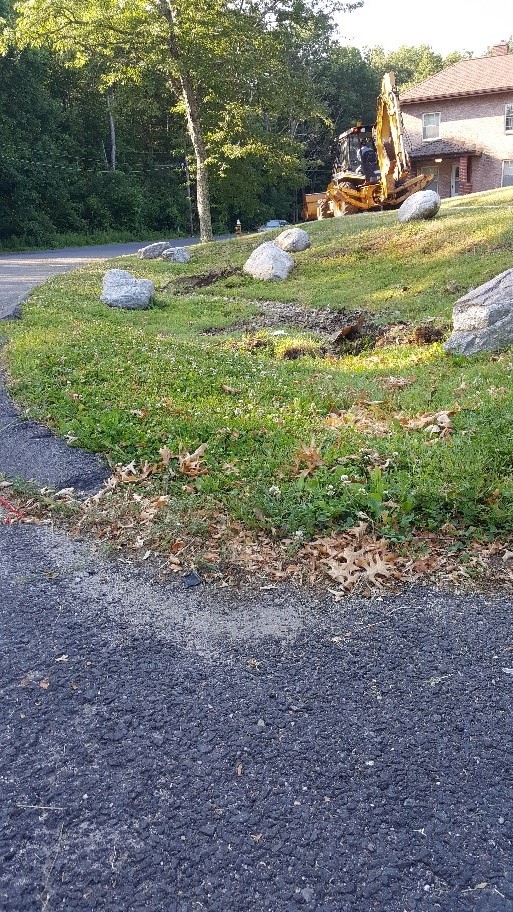
Despite our best intentions, sometimes things don’t go as planned. As part of its commitment to reducing stormwater impacts to our local streams, UConn installed a rain garden at Mansfield Apartments in 2010. Unfortunately, it was not maintained and the garden failed. Fortunately, a collaboration of several groups helped to renovate this garden and restore its functionality.

1
Rain garden before renovation. Turf dams had grown in and prevented water from entering, and all of the plants had died.

UConn’s landscape services provided heavy equipment to removed excess material from the garden, and they also provided stone for the “river channel” to prevent erosion. New plants were purchased with help from the Office of Environmental Policy though the UConn Campus Sustainability Fund. Students from UConn’s Natural Resources Conservation Academy (http://nrca.uconn.edu) used the garden as their project during their week-long natural resources field experience on campus. This exciting program brings high school students from around the state to UConn to learn about many different aspects of natural resource conservation. Working with Mike Dietz, students replanted and mulched the rain garden, and prepared a presentation about the project to all of the parents on the final day of the NRCA.

So in the end, functionality has been restored to a failed rain garden, and the project turned into positive learning experience for an outstanding group of students!


Michael Dietz, PhD

Water Resources Educator

CT Nonpoint Education for Municipal Officials (NEMO) Progam/CT Sea Grant Program
University of Connecticut

UConn goes for the (LEED) Gold!

July 1, 2016

Happy 4th of July to friends and followers of the OEP!  Here’s some UConn green campus news also worth celebrating.

Earlier this week, UConn’s Board of Trustees voted unanimously, on the recommendation of its Building, Grounds & Environment Committee, to upgrade UConn’s longstanding Sustainable Design & Construction Policy.  The new mandatory performance standard for all construction and renovation projects exceeding $5 million will be LEED Gold, as certified by the USGBC.

Our minimum performance standard under the old policy had been LEED Silver since March 2007, when UConn was among the first public universities in the nation to require certification at this level.  Since then, our green building track record has been excellent, much to the credit of our Planning Architectural & Engineering Services Department at Storrs and the Planning, Design & Construction Department at the UConn Health Center in Farmington.  Since 2007, UConn has had 34 projects that were at least LEED Silver registered or certified, representing more than 3.3 million square feet, and including four LEED Gold certified projects. We’ve won green building and energy efficiency awards for many of these projects, and they’ve been a significant factor in our high green campus rankings over the past five or six years.

UConn’s resource-efficient new construction, together with our steady commitment to energy efficiency measures in existing buildings[1], is saving the University millions of dollars each year in energy costs and keeping us on track with our Climate Action Plan goal of reducing our carbon footprint by at least 20 percent by 2020 (against the 2007 baseline). This achievement is well within our reach, despite the concurrent growth in enrollment and campus building square footage during this 10-year period.

This upgrade of our green building policy was overshadowed by other agenda items covered at the June Board meeting, including approval of UConn’s operating budget for the next fiscal year and the unprecedented revocation of an honorary degree granted to comedian Bill Cosby in 1996. But, for UConn’s strong network of environmentally-minded students, faculty, staff, alumni and others, this LEED Gold policy news doesn’t take a back seat to anything else.  If you happen to see a senior administrator or UConn Board of Trustees member, thank them for keeping UConn on the leading edge of green building!


[1] These energy conservation measures include more than 20 significant building retro-commissioning projects, the ongoing campus-wide retrofit of all interior and exterior lighting to LED by 2020, and the extensive steam/condensate system replacement project.


Welcome UConn’s first full-time Sustainability Program Coordinator

June 10, 2016

After a search that yielded more than 100 applicants from across the country, the Office of Environmental Policy (OEP) is pleased to welcome Sarah Munro as UConn’s first full-time Sustainability Program Coordinator. Sarah will be responsible for supervising student staff in the OEP’s Sustainability Office, developing, planning, and administering sustainability initiatives and events across campus, chairing the EPAC Recycling Workgroup, maintaining the OEP’s (EcoHusky) website, and developing and publishing OEP newsletters and outreach materials.

Prior to joining the OEP as a full-time employee, Sarah worked at the OEP as a graduate student sustainability coordinator for 2.5 years.  During that time, she was also a UConn EcoHouse graduate assistant, and teaching assistant for a Sustainable Energy course co-sponsored by UConn’s Departments of Political Science and Chemical Engineering.

As a graduate student sustainability coordinator at the OEP, Sarah led and assisted with the implementation of various initiatives, including:

  1. Organizing UConn’s first trip to the UN’s annual climate summit (COP21 in Paris) with a group of students, faculty and staff from departments across campus;
  2. Overseeing the development of outreach and engagement activities (Green Office Certification Program, Green Campus Academic Network, 2014 Sustainability Progress Report);
  3. Collaborating with departments across campus and OEP interns to fill out detailed Sustainability Tracking, Assessment and Reporting System (STARS) survey data that helped secure UConn’s top 10 position in the Sierra Club’s Cool Schools and World University GreenMetric rankings, for the 4th and 5th consecutive years, respectively.


Munro
Sarah Munro promoting EcoHusky Nation in Budapest, overlooking the Danube River, during her recent vacation abroad

Sarah holds a B.A. (triple major) in Political Science, German, and International Studies: Europe, from Guilford College in N.C., an M.A. in International Relations (focused on EU environmental policy) from Central European University, and an M.A. in Political Science from UConn. She is currently a Ph.D. candidate in the Department of Political Science at UConn.

The OEP is very excited about the possibilities that this new hire brings. Please join us in welcoming Sarah as UConn’s Sustainability Program Coordinator.

UConn Wins GreenCircle Sustainability Award

June 7, 2016

UConn recently received a 2016 GreenCircle Sustainability Award presented by the CT DEEP, in conjunction with the Hartford Business Journal. The GreenCircle Award Program was established in 1998 to recognize Connecticut businesses, institutions, individuals, and government entities who have gone above and beyond to reduce energy and climate change, water usage, improve waste management and recycling, as well as sustainable civic improvements and innovations.

Green Circle
A Proud UConn contingent accepting the DEEP’s 2016 GreenCircle Sustainability Award during a ceremony held at Hartford’s Infinity Hall on May 23rd. DEEP Commissioner Rob Klee (front left) presented the award. See below for a listing of UConn attendees pictured.  Photo Credit J. Fiereck Photography

The GreenCircle award came in recognition of UConn’s many diverse sustainability initiatives and projects to reduce its environmental footprint, consistent with UConn’s Climate Action Plan (CAP). To date, UConn has registered or certified 23 LEED projects (2.2 million sq. ft.) at the main Storrs campus, including 3 LEED Gold-certified buildings.  Also, four of UConn’s dining halls are Green Restaurant Certified for serving local organic and third-party verified food and for reducing water, energy, and food waste. UConn also strives to reduce emissions from transportation. In 2015, Rec Services implemented a new Cycle Share program that enables use of bicycles for a week, month, or semester for anyone with a UConn ID, at a nominal cost. In addition, two new electric vehicle (EV) stations are free for use by commuters, and will help power UConn’s fleet that is already 15% hybrid or EV.

To help meet the University’s 2020 carbon reduction target under the CAP, and achieve a goal of net zero energy and water growth, as part of the Sustainability Framework to UConn’s new Campus Master Plan, Facilities began a 5-year re-lamping program to replace all indoor and exterior lighting with ultra-efficient LEDs. In addition, low-flow faucets and aerators were installed in all student residence halls and apartments, saving between 50,000 and 100,000 gallons of drinking water per day.
Beyond operational initiatives, UConn implemented several programs on campus designed to promote more sustainable behaviors and increase engagement. UConn’s Green Office Certification Program enables staff to self-assess the relative sustainability of their offices. By the end of 2015, 30 offices across campus had been certified as Green Offices. Meanwhile, the 9th annual version of UConn’s inter-dormitory EcoMadness energy and water conservation competition inspired students to reduce water and electricity use by as much as 35% in the winning dorms. To raise awareness among faculty about opportunities for engagement in campus sustainability actives, in 2015 UConn also established a Green Campus Academic Network (GCAN). This led to more environmental class projects and research with on-campus demonstration components, like rain gardens and air monitoring stations. Ultimately, GCAN also led to UConn@COP21, whereby a group of 12 students, 4 faculty members, and 2 sustainability staff traveled to Paris, France for the 21st annual UN Conference of Parties climate summit.

In addition to the University winning the 2016 GreenCircle Award, UConn’s Department of Natural Resources and the Environment (NRE) was named a finalist for its work in training environmental professionals. The finalist award specifically recognized the work of NRE professor, Dr. Gary Robbins. Over the past 30 years, Dr. Robbins has trained and educated young professionals, developed the first approved online continuing education courses for Licensed Environmental Professionals, and has provided hands-on field training for DEEP staff.
The 2016 GreenCircle Award and Finalist Award recognize UConn for its comprehensive efforts at reducing the University’s environmental impact and raising awareness for sustainable behaviors. UConn’s continued commitment to sustainability promises to reinforce its growing reputation as one of the greenest universities in the country.

A special thank you to all of the UConn members present to receive the DEEP GreenCircle Sustainability Award on May 23rd in Hartford:

  • Office of the Executive Vice President for Administration and Chief Financial Officer
    • Scott Jordan, Executive Vice President for Administration & CFO
  • Facilities
    • Stan Nolan, Director, Utility Operations & Energy Management
  • Transportation and Parking Services
    • Bill Wendt, Director of Logistics Administration
    • Dwight Atherton, Parking Manager
    • Charlie Grab, Business Services Supervisor
  • Office of Public Engagement
    • Julia Yakovich, Program Manager for Service Learning, Office of Public Engagement
  • Faculty
    • Mike Willig, Professor, Department of Ecology and Evolutionary Biology; Director, Center for Environmental Sciences and Engineering (CESE)
    • Oksan Bayulgen, Associate Professor, Department of Political Science
    • Tracy Rittenhouse, Assistant Professor, Department of Natural Resources and the Environment
  • UConn Recreation (UConn Cycle Share)
    • Jay Frain, Director
    • Mike D’Alfonso, Associate Director, Programming & Special Events
  • Office of Environmental Policy
    • Rich Miller, Director
    • Jason Coite, Compliance Manager
    • Paul Ferri, Environmental Compliance Professional
    • Mark Bolduc, Environmental Compliance Professional
    • Sarah Munro, Sustainability Coordinator
    • Eric Grulke, Sustainability Coordinator