Samantha Glass, Ph.D. Candidate in Oceanography
Dialogue. Consensus. Action. If you were in Antalya, Turkey for COP31, you would find these words displayed everywhere. After three days here, I would argue that there should be a fourth: Inevitability. Inevitability has surfaced in multiple topics: the 1.5 °C temperature overshoot, carbon dioxide removal (CDR) and geoengineering strategies, artificial intelligence (AI) implementation, and polar sea ice loss. Across conversations, presentations, and negotiations, there seems to be a marked shift in how people are talking about climate change impacts and interventions compared to previous years.
On my first day at the conference, Monday, November 16, I attended a plenary session discussing scientific updates in our rapidly changing world and strategies for avoiding tipping points and managing overshoot. The writing on the “wall” was very clear: a 1.5 °C overshoot is inevitable. The commitments made under the Paris Agreement have not translated into sufficient implementation or emissions reductions to prevent temperatures from exceeding the 1.5 °C threshold. This reality makes many other climate impacts increasingly inevitable. Consequently, much of the conversation is shifting from how to avoid overshoot toward how to shave its peak, limiting its magnitude and duration.
As a graduate student wrapping up my PhD in polar marine carbonate chemistry, I have spent years thinking about how CO2 moves between the ocean, atmosphere, and sea ice. The relationship between warming ocean temperatures and sea ice loss is not abstract to me. Similarly, having also previously worked on a project focused on CDR technologies, this conversation was not entirely new to me. Every emission pathway assessed by the Intergovernmental Panel on Climate Change (IPCC) relies on CDR technologies to achieve net-zero and negative CO2 emissions. However, it seems some participants are only now reckoning with what this means in practice.
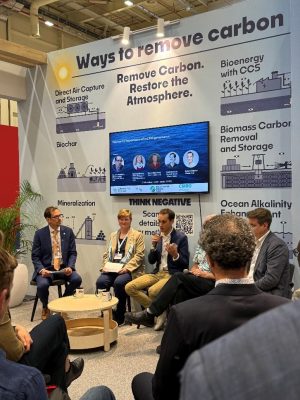 Across my first three days, I have explored a wide range of discussions spanning science policy intersectionality, climate science communication, CDR policy development, ocean and cryosphere science, the launch of the second Global Stocktake, and the negotiation process itself. I have been pushed to think more critically about feasibility as well as funding mechanisms and their limitations. Additionally, my interests have led me to engage in conversations about current trust in the IPCC and how challenges to scientific credibility can become distractions from the urgent need for action and implementation.
Adding inevitability to the COP31 messaging would reflect the growing recognition that some things can no longer be avoided. In fact, many impacts are not future possibilities but are already being experienced around the world. This recognition, thus, challenges us to understand the reality of what is at stake and use that to shape decisions.