UConn@COP

The UConn@COP Fellowship Program strives to build future leaders in climate science and policy and to promote UConn’s leadership on climate change and sustainability issues through four main pillars:

1) Student Engagement
2) Experiential Learning
3) Interdisciplinary Group Discussion
4) Cultural Immersion

Participating fellows are selected through a highly competitive application process that considers GPA, relative extracurricular involvement, and an essay that speaks to their interest in the program.

The following blog articles have been written by past and present UConn@COP fellows, faculty, and staff, as well as by students who have attended events recapping the UConn@COP experience on campus.

Inside the Negotiation Rooms: A firsthand look at COP@30 Dynamics – Malak Nechnach

COP30 negotiations

Attending COP@30 has been a privilege; it has offered me the opportunity to engage with people from all over the world and hear diverse perspectives on climate solutions. The conference is well organized overall, though the usual delays in starting meetings were noticeable. With negotiations, side events, and pavilion talks happening simultaneously, it can quickly become overstimulating; however, I have already learned so much from the wide range of sessions I’ve attended.

The most meaningful part of COP@30 for me has been speaking directly with delegated and youth representatives. I had an amazing conversation with a student from the University of Oslo representing YOUNGO – the official children and youth constituency of the UNFCCC. We discussed pathways for youth involvement, and the types of actions young people have taken within the climate movement. I also had the opportunity to speak with members of both the French and Algerian delegation including Algerian negotiator Khaled Bassim with whom I discussed elements of the Sharm El-Sheikh Implementation Plan, which focuses on operationalizing funding for loss and damage, since there had been a new report about it posted the previous night.

Despite how valuable these conversations have been, the negotiations remain (in my opinion) the most interesting part of my experience. Negotiations take place in large rooms filled with country representatives, each attempting –often unsuccessfully- to reach a consensus. So far, two negotiations in particular have deeply shaped my understanding. The first was “Climate Change and Mountains” and the second one was “Special Needs and Circumstances of Africa”, which happened on Monday – my first day at the COP. This last session was intended to address four concrete agenda points outlined by the COP President, yet none of the points were discussed. As the delegate form the United Republic of Tanzania put it, the session devolved into a “vulnerability contest” between Africa versus the rest of the world. Countries such as Chile, Panama and Guatemala questioned why a meeting focused on Africa was necessary, arguing that many developing regions face equal levels of suffering. Most Latin American countries spoke in similar alignment under ILAc (Independent Alliance of Latin America and the Caribbeans). The delegates from South Africa and the African Group attempted –unsuccessfully- to bring the discussion back to the agenda reminding the room that despite contributing less than 4% of global emissions, Africa is both one of the least responsible and most vulnerable regions, projected to surpass the 1.5C threshold as early as 2040.

Malak in front of COP30 signIn response, one of the delegates argued that the meeting violated Article 4.8 of the Paris Agreement, which in my opinion was a complete misinterpretation. Article 4.8 emphasized equity and differentiated responsibilities, not uniform treatment under different circumstances. The entire meeting felt unproductive and at times, unprofessional, with several parties appearing to delay the conversation instead of contributing to it, which is why I am looking forward to reading the official written report of this meeting!

Overall, there are countless negotiations happening at all times. A lot of them are focused on specific paragraphs of previous agreements which are very interesting, but I especially enjoy the presidency-led meetings where the structure is clearer and discussions more focused.

Over the next few days, I plan to continue speaking with delegates from different countries, attend additional negotiations, and ask questions whenever possible. This experience has already expanded my understanding of international climate diplomacy, and I am excited to continue learning!

Malak Nechnach is a senior studying Physiology and Neurobiology with a minor in Mathematics.

Navigating the Noise at COP30 – Andy Zhang

Andy Zhang in front of China's COP30 pavilion.These past few days have been amazing! My first days were spent wandering around and feeling a little lost, but once I became familiar with the venue it was exciting to see all the different pavilions. It felt strange to walk through the space and see pavilions for China and India filled with activity, while the United States was essentially entirely absent despite being the largest historical emitter. Within several sessions, it felt frustrating because people talked in circles. The same phrases kept coming up, the same statements about urgency, the same calls to action. Yet it felt like no one wanted to put themselves on the line for the collective wellbeing for change to happen. I found myself wanting more honesty and more direction. It was hard to watch so many people speak passionately without feeling any movement toward concrete solutions. This experience also in many ways highlighted the larger paradox of global climate action. We need a coordinated global response to climate change, but it requires the willingness of countries to participate.

Students in front of COP30 Sign


Every nation needs Nationally Determined Contributions and climate goals, yet it must be left to each country to decide how to

 reach those goals because climate impacts differ so widely. This makes it incredibly difficult to come to a consensus when so many stakeholders have different needs, capacities, and responsibilities. Even with these challenges, I am excited for what is still ahead. I am looking forward to exploring more of the Blue Zone programming, attending sessions that focus on food systems and adaptation, and see how negotiators approach the later stages of discussions as COP starts to wind down. There is still so much to learn, and I am excited for the days to come. 

Andy Zhang is a senior studying environmental economics and environmental sciences.

The Debate of Women’s Rights at COP30 – Madelyn Kelly

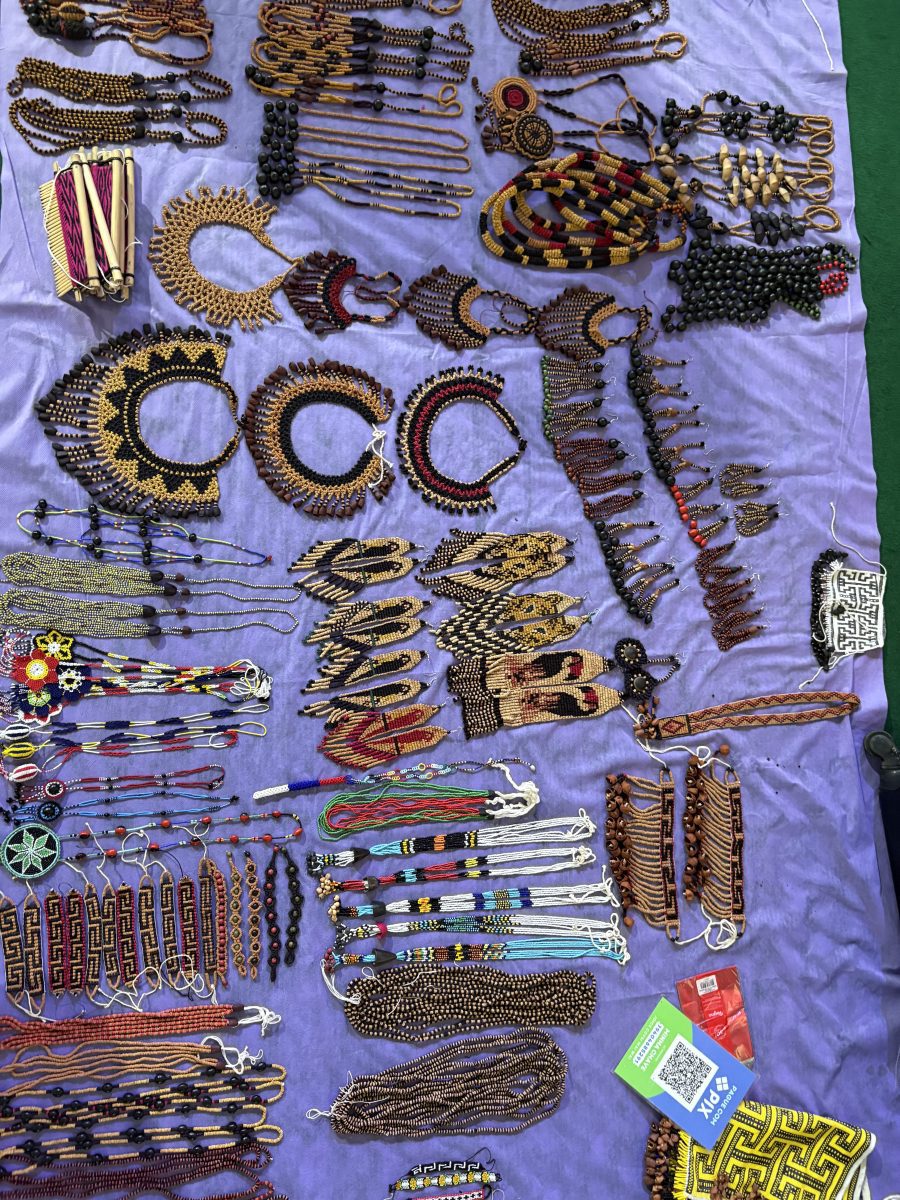
Beaded necklaces on a blanket.
Indigenous crafts for sale in the Green Zone.

Overwhelming is the first feeling that consumed me as I walked into the COP30 venue. Never have I been surrounded by such a diverse group of people and cultures.  It is hard for me to comprehend how delegates representing the over 190 UN countries present are peacefully existing under one (ENORMOUS) roof when their countries have historically had major conflicts.

While cordial, tensions were observed in the first policy discussion that I attended. This meeting was an informal session discussing the Policy and Strategy for Gender Equality and the Environment. I was disappointed to hear the lack of support for women’s equality and education in the language of the legislation document. The male Russian delegate requested that language be removed that required the equal representation of men and women in each country’s delegation. The male Iranian delegate backed this statement by saying that they do not have the resources to have equal representation of women in the delegation. Doubling down on this, both parties supported the change in wording from supporting/requiring “education” on gender and climate change to “training.” If education is not given to both men and women, then no, there will not be equal representation of men and women in the delegation (which extremely frustrated me). Additionally, the Saudi Arabian delegate, who was a woman, agreed with Russia and Iran and expressed disagreements with the advancement of women’s reproductive rights.

I know, I know, my first thoughts were also to be extremely upset and disappointed by these delegates (especially the woman), but I am not anymore. I cannot blame the individual delegates for statements that they may or may not support personally. Before this conference, I did not realize that delegates are given strict instructions on the stances they are allowed support. Deviating from the guidelines set by the higher levels of government could result in firing or more extreme measures in some countries.

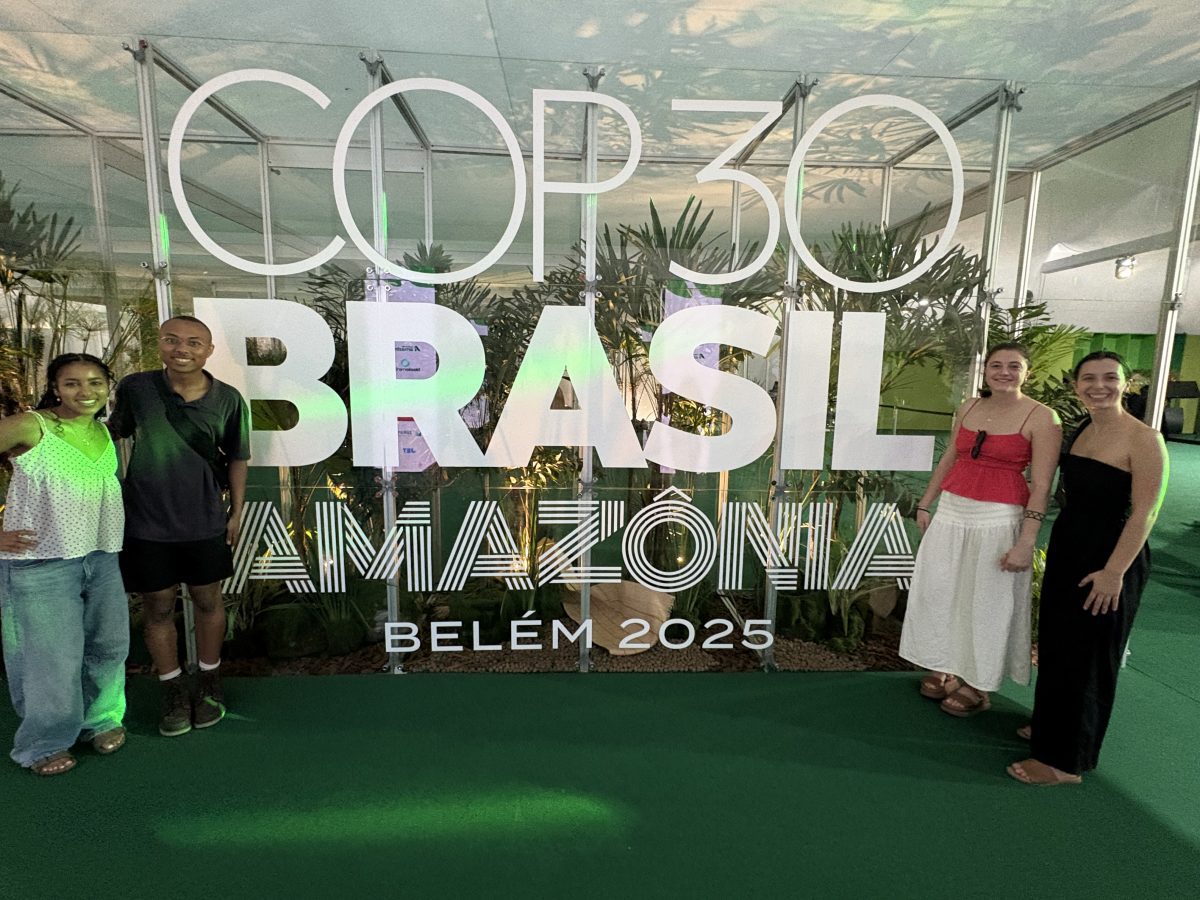
Students in front of a COP30 sign.There is so much more I could go on about and so many valuable observations and pieces of information I have learned in the first 3 days I have spent at COP. I will quickly fire off some final thoughts (some inspiring and some discouraging) since landing in Belem: The culture in the Amazonia region of Brazil is deep and rich, the Indigenous Tribes in Brazil do not feel like their voices are getting proper representation in the conference, it is controversial that Brazil is advocating for Rainforest conversation while expanding oil drilling, it is crazy that international legislation is being written before my eyes, and how can any real action come from these “agreements” that are only enforceable by “peer pressure” and driven by economic benefits?

I am extremely grateful for this experience and cannot wait to explore these questions as I engage in COP for the next 2 days.

Madelyn Kelly is a senior environmental engineering student.


Stories From COP30 and What I Learned About Our Ocean – Anagha Payyambally

We wanted to begin COP30 not inside the venue, but by grounding ourselves in the culture, people, and nature of the region. That’s why our group travelled to Mocajuba, Pará, where we met the Amazon river dolphin, the boto, and spent time with local communities, learning about their traditions and enjoying their food. People spoke about the botos with pride, and it was easy to see why. These dolphins are incredibly intelligent and friendly with humans. One story that stayed with me was how they help fishermen by guiding them to fish-rich areas and even forming a boundary to trap the fish. Standing by the river, listening to stories from people who live with the forest and water every day, felt like the right way to enter a climate conference that tried to center local communities and their voices.Anagha Payyambally with an Amazonian dolphin.
My first day at COP30 took place in the Green Zone, where Indigenous communities stood at the center, wearing traditional outfits, selling handmade products, and filling the space with languages and knowledge systems that rarely receive global attention. Almost every event was in Portuguese, created for those who feel the weight of climate change first. It felt honest. It felt necessary.
When I moved into the Blue Zone for the following days, I focused on ocean-climate nexus talks, especially those addressing marine pollution, ecosystem losses, and ocean protection. Each session reminded me how fragile the ocean is and how fast we are losing time. One moment that stayed with me came from Brazilian sailor Torben Grael, a five-time Olympic medalist, who said that when he began sailing 50 years ago, he never saw plastic in the ocean. Today, he sees microplastics everywhere. The heaviness in his voice conveyed more than any graph or dataset.
Across the sessions, the call to protect 30 percent of the world’s oceans by 2030 was repeated again and again, echoing the UN’s Global Biodiversity Framework. The newly released Global Tipping Points report was another urgent highlight, especially its warning that coral reefs have crossed a threshold that may not be reversible. Panelists highlighted the need for a Global Coral Reef Summit in 2026 to rally the world around what remains.

COP30’s Oceans Special Envoy, Marinez Scherer.
Fellow Anagha with COP30’s Oceans Special Envoy, Marinez Scherer.

What moved me most at COP30 was the structure of the conversations in some of the sessions. Panels began with community voices, including Indigenous leaders and local people who rely on the land and ocean daily. They spoke about what they are seeing, what they are losing, and what they need. Government officials followed by outlining the actions they are taking now and the actions they can still pursue. It felt like real dialogue, like policy finally listening to lived experience. I also want to applaud the Brazilian government for what they modeled here. During my conversation with COP30’s Oceans Special Envoy, Marinez Scherer, she said that Brazil wanted to show the world what climate leadership looks like when biodiversity, Indigenous knowledge, and justice are treated as the foundation. She hopes Brazil’s approach inspires other nations to act with the same urgency.
Halfway through the conference, I realized something important: climate action doesn’t only happen in negotiation rooms. It begins in fishing villages, on riverbanks, and in the everyday knowledge of people whose lives are closely tied to nature.

Anagha Payyambally is a marine sciences graduate student.

UConn Gives 2025

UConn Gives, the annual 36-hour fundraising event at UConn, will be taking place on April 21 and 22. Every year, the UConn community rallies to support many different causes on campus, including our own Campus Sustainability Fund and the UConn@COP Fund!  

The Campus Sustainability Fund (CSF) finances programs and initiatives that support students and advance UConn’s position as a global leader in university sustainability. Contributions to the CSF provide critical funding of transformative learning experiences for students including hands-on professional development through internships and research projects that nurture our natural environments, improve health and wellbeing, and enhance environmental justice in the communities which we serve. The CSF also funds our experiential learning events such as the Haunted HEEP, the UConn-famous annual haunted trail walk at the Hillside Environmental Education Park.  

The UConn@COP Fund supports the UConn@COP Fellowship program, helping the OS send a cohort of students each year to the annual United Nations Conference of the Parties. Through UConn@COP, students have participated in panels at international press conferences, networked with global environmental leaders, and heard from and interacted with international delegates and core members of international environmental justice movements. UConn@COP is an incredible, transformative experience for fellows, and it would not be possible without the support of generous donors! 

Every donation, big or small, means so much! Thank you to everyone for supporting sustainability achievements and the environmental leaders of tomorrow! 

There With You – Colin Rosadino

As a law student, I was very excited to witness the bureaucracy of global governance firsthand at the COP. I did not really know what to expect. I have read about these conferences since I was in high school; I have studied the Paris Agreement and researched its impact; and, as a climate activist, I have always been intrigued by the international legal dimensions of the issue. To travel halfway across the world and see everything, in full form, felt incredibly surreal. At no other time in human history have delegates from every country in the world sat around a table and developed universal treaties together. And yet, while this is emblematically the height of global, liberal democracy, the context surrounding it could not have been more disquieting. The United States just elected a President that attempted to violently overthrow the nation’s last election; committed to imprisoning his opponents and killing asylum seekers, calling them animals, thieves, and criminals; and openly vowed to do the bidding of the fossil fuel industry for a billion-dollar bribe. More bombs have been used to kill Palestinians in Gaza than were dropped in Dresden, Hamburg, and London combined during World War II. The war in Ukraine is still being waged. And natural disasters, droughts, heat waves, and famines are destroying communities and taking people’s lives at record levels every successive year.

I knew going in that COP was not the solution to any of that. But it is difficult to see everything progress as normal when these challenges really demand so much more. The most important thing I took away from the conference this year is that a new political alignment is necessary. There is an incredible dissonance you feel walking through the halls of the conference, but for anyone who gets the opportunity to attend a future COP the one thing that you will notice is just how many people are there with you. There are thousands of young people, thousands of experts and activists and scientists. The will and the energy are not lost. The institutions, as they currently exist, might be. COP might be a solution in the future, it might not be. But the impetus for trying that system was important. It still resonates. Millions of people are organized and demanding something different and the conference is just one location where solidarity within that movement can be felt and formed.

When you participate in this program, your role as an active force in history begins. Everything you see that is unjust or too slow or too ineffective or too captured: that is your project. Even if you fear that the institutions tasked with solving a problem are ineffective, it is always important to recognize where power is, how it is being used, and to develop theories to wield it more effectively. One of the most impactful tools of the legal profession is the power to decide what is legitimate and what is not. That can be weaponized, or it can be used earnestly to protect people, but the worst thing we can do is ignore it because it is failing at the latter. COP itself is a legal institution with the power to legitimize a path forward. And everywhere you see unity; people fighting for what is just, in spite of violent opposition; defending one another; and traveling thousands of miles to make their voices heard, that is where you build the resilience to take on those fights. That is how we create a politics for a more impactful, just, and democratic international governance. The will to create that is there and I am so grateful for the experience of attending COP because it gave me the opportunity to bear witness to all of that. More clearly now than ever, I know where I need to put my energy.

Colin Rosadino is a law student at the UConn School of Law.

Climate Justice is Hard, but We Must Fight for It – Sydney Collins

Climate justice is a confusing thing. You want to believe it, understand it, see it, and address it. But, it’s honestly confusing, messy, and quite frankly disruptive.

This is my second time having the privilege to attend a COP. My first COP, which was COP27 in Egypt, was my first real unraveling of climate justice. I always believed myself to be someone that cared about social issues, and then felt it was my responsibility or moral imperative to understand climate justice. 

At COP, there is an incredible display of climate leaders from around the globe. From Ministers in the EU making climate finance deals to frontline communities in South Africa screaming at the top of their lungs to demand justice for their lives. It was the first time I felt in my bones how unequally different communities across the earth were to be affected by the climate crisis, and how it felt. How it felt to them, their reaction to it, and how it felt in my body.

I knew it was an injustice. Although, not only how unequally consequences of climate change were to be felt, but something more pervasive. I was lucky to have university professors on the trip, including Phoebe Godfrey, that were welcoming enough to hold my hand to the learnings of climate justice. 

Climate justice revealed to me that the roots of the climate crisis are not just greenhouse gas (GHG) emissions, but the legacy of decades long exploitation of people and our planet in the pursuit of profit. It doesn’t just look at GHG emissions at the problem, but rather as the symptom of a systemic wide problem of what our society values and the harm it’s willing to conduct to achieve it.

Now, it’s time to hold space for how this feels. This is scary. This makes my bones hurt. My heart deflates, and genuinely rattles my body with fear. What was already a complicated and atrocious problem of GHG emissions, just got bigger and more complicated. Climate justice seeks to unpack the power and politics that is wrapped up in the climate crisis that often attempts to be shielded. 

At COP29, this year I wanted to continue my understanding of the complexity of climate justice. This past year, I had been exposed to a lot of learnings around the impact of the military and global war as tied to the climate crisis, highlighted by the wars in Gaza, Ukraine, and Sudan, and how it prevails to upholding, perpetuating, and causing global injustices. I had also learned more about topics including colonialism, imperialism, capitalism, and facism – how these concepts are defined and how they present themselves in policy and practice. 

Climate justice is overwhelming. And I wanted COP29 to give me more clarity and insight on what climate justice is, how to communicate about it, and how to address it. I wanted to understand my role in climate justice and climate injustice, and how I can be an individual person and community member in the movement. I want to give my mind, body, and soul to the folks at the frontline, and fully absorb and embody the struggles they are amplifying and what actions they are asking for.

And to be frank, I struggled. I would listen in on education events, and be filled with self-doubt, confusion, and fear around messaging and desperately trying to find the truth. My heart would feel one thing, and my mind would take my body in another direction. Some webinars would talk about capitalism, some would not. Some events would digest the military, some wouldn’t with a 10-foot pole. If I want to amplify climate justice, who am I to listen to? What am I to amplify? What am I to unpack in myself, and how do I not reaffirm false narratives and perpetuate harm?

One of the last events that our team went to during the Blue Zone at COP29 was the People’s Planetary. This event included community activists at the frontlines of climate injustice across Palestine, Lebanon, Sudan, Africa, and more to vocalize the reality of their experiences. It was one of the first events of COP29 where I got to experience people just fully telling their truth. A Palestinian activist showed footage of people being brutalized by the Israeli military and their homes being bombed. A Lebanese activist shouted how their family was being attacked and how afraid they were. A Sudan activist cried on how no one was talking about Sudan while people were being murdered. She could barely get through their sentences. 

I felt afraid. Scared. Sad. Those feelings didn’t go away with this event. They intensified. However, it was one of the most important events I could have attended at COP29. Activists weren’t performing a stunt. They weren’t academics trying to prove a point, or industry trying to paint a certain image for their brand. They were just being honest. They were being real about their experiences, and how the powers that were not investing in climate finance at COP29, including the Global North, were raveging and sacrificing their communities. Murder and harm is ugly and disgusting, but it’s a reality of people in the Global South and what the fossil fuel industry and militarized countries have done and will continue to do to communities. 

This event showed me that to understand climate justice is not to be perfect, an academic, or the most experienced person in the room. It’s about being brave, and honoring the truth of what powerful countries and fossil fuel industries have done to our planet and people.

These activists at the frontline know this truth because it’s a part of their lived experience. They cannot look away, and watch their communities be harmed and die. We must listen to them, and be brave enough to feel it in our bones. We must grieve, be sickened, and feel empowered enough to talk about it in our communities and shout it at the people in power. Not only because we should care about our brothers and sisters that are in harm’s way, but also it’s the only way to address the climate crisis honestly. Systems based on exploitation, violence, dominance will never serve the people, but only the interests of money and the people in power.

This article itself was hard to write. I was worried I would talk about climate justice wrong or say the wrong things. But, what I want to take from COP29 is to not be afraid, and trust myself to know the truths that I have heard. We must call out the Global North, the military, the fossil fuel industry for the harms they have perpetuated and the power they hold.

I ask you to stand with me, hold my hand, and be brave enough to amplify this truth as it is. Let’s talk about colonialism, racism, capitalism, imperialism, facism, militarism. Let’s see what we know and what we need to learn. We can be sad and afraid, but we can do it together just as we did at the People’s Planetary. This is where we can seek liberation from the climate crisis – not in resisting the truth, but resisting exploitation and aiming for revolution. 

Sydney Collins is a Campus Climate Action Corps Connecticut – Climate Action Leader with the Office of Sustainability. She was also a UConn@COP Fellow in 2022.

Reflections from COP29: Progress, Gaps, and the Road Ahead – Mayowa Oladele

Mayowa Oladele at COP29I arrived at COP29 in Baku, Azerbaijan, with a mix of hope and skepticism. With the world’s temperature getting close to the 1.5oC threshold, the stakes couldn’t have been higher. What struck me from the outset was the diversity of voices—from grassroots activists amplifying the concerns of the most vulnerable to policymakers navigating the complex web of international negotiations. This convergence reaffirmed a fundamental truth: addressing the climate crisis demands both collective resolve and individual responsibility.

As the conference unfolded (I joined in its critical final week), the outcomes, while not shocking, left me pondering on the progress we’ve made and the gaps we’ve yet to close. Here are my key takeaways:

  1. Financing Gaps: Progress, but Far from Equity

Let’s start with a win. The headline commitment to triple climate finance from wealthy nations to $300 billion annually by 2035 was a significant step forward. Yet, even as I welcomed this progress, the numbers felt glaringly inadequate.

The reality is stark: developing nations need trillions, not billions, to meet the dual challenges of mitigation and adaptation. And much of this funding still comes as loans, deepening the debt burdens of countries already grappling with the devastating impacts of climate change.

One promising aspect was the acknowledgment of private finance as a critical lever to scale climate action. If harnessed effectively, it could bridge the gap between pledges and the real resources required. But to meet our net-zero goals by 2050, wealthy nations must do more—both in terms of direct contributions and by creating systems that ensure equitable access to funds.

  1. Fossil Fuels: The Elephant in the (Drafting) Room

This was, without question, one of the most frustrating aspects of COP29. After nearly three decades of climate summits, the absence of a clear, actionable plan to phase out fossil fuels was glaring. Hearing the passionate pleas of activists and vulnerable communities during side events made the lack of progress on this front even harder to stomach. Ignoring the complete phase out of fossil fuel is like treating the symptoms without addressing the disease.

  1. Carbon Markets: A Rare Bright Spot

If there was one area where progress felt meaningful, it was carbon markets. I’ve been skeptical of these mechanisms in the past, given their history of loopholes and greenwashing. But this year marked a turning point.

For the first time, we saw real clarity on the rules for emissions trading under Articles 6.2 and 6.4 of the Paris Agreement. These guidelines are critical to prevent double-counting and ensuring transparency. While not perfect, they offer a foundation to rebuild trust in carbon markets and attract investments into crucial areas like reforestation, nature-based solutions, and carbon storage.

The challenge now is implementation. Robust enforcement mechanisms will be essential to maintain credibility, and it will take a concerted effort to ensure these markets deliver real, measurable impacts.

Mayowa Oladele COP29

As we turn toward COP30 in Belém, Brazil, I’m left with a mix of hope and urgency. There’s however an opportunity here. The updated Nationally Determined Contributions (NDCs) due next year could inject the ambition we didn’t see in Baku. Brazil, as host, has already shown leadership with its ambitious emissions reduction target, and I hope this sets the tone for more transformative action.

Every COP reminds me of the duality of this process. It’s frustratingly slow, often bogged down in politics and compromises. And yet, it’s one of the few spaces where the entire world comes together to confront the climate crisis. For me, COP29 reinforced the importance of pushing for systemic change—not just within the negotiations but also in how we approach the climate crisis more broadly. Whether it’s finance, fossil fuels, or adaptation, we need bold, collaborative action that matches the scale of the challenge. Incrementalism isn’t going to cut it anymore.

As I left Baku, I felt a mix of exhaustion and determination. The road ahead is daunting, but if there’s one thing I’ve learned, it’s that the fight against climate change is worth every step.

Mayowa Oladele is a Ph.D. candidate in Chemical and Biomolecular Engineering.

Why Should We Prioritize the Climate Crisis? – Amanda Stowe

In a world with so many problems and conflicts why should we prioritize the climate crisis? Almost every single humanitarian challenge the world faces can be tied back to the climate crisis, and this was highlighted in many of the panels and discussions at COP29. Examples of these challenges include water scarcity and water wars, poverty, human rights issues, food scarcity, disease, and economic instability. Thus, we cannot work on solving these issues without considering and simultaneously finding solutions to the climate crisis. 

People holding many feet of paper with victim names on them
A continuous list of all the victims who have died in Gaza displayed at the People’s Plenary.

One of the parts of the conference I attended that especially highlighted this connection was the People’s Plenary, which was led by Rise for Climate Belgium. This meeting featured speakers who were personally on or have family who is on the frontlines of the Israel-Russia crisis. Speakers explained how this crisis reflects many of the environmental issues that already exist in this area. The purpose of this plenary meeting was to call attention to the intertwined climate and human rights issues that are present in this part of the world as well as the importance of developed countries stepping up and paying their share of climate reparations. For me, this was a very powerful, emotional, and motivating meeting that informed me on the crisis, its connections to climate, and how countries can work together to attempt to solve the conflict. 

The concept of environmental justice highlights the interconnectedness of climate and human rights issues, as it demonstrates how certain groups are disproportionately affected by environmental issues. The current situation in Gaza is one example of environmental injustice, but there are many other examples across the world.  

I attended the panel “Insights from the UNEP Emission Gap report and UNFCCC NDC Synthesis Report,” which discussed how greenhouse gas (GHG) emissions are significantly larger in many developed countries but are disproportionately affecting developing countries who are contributing very little to global GHG emissions. For example, U.S. GHG emissions are three times the global average and China’s GHG emissions are two times the global average. GHG emissions of these powerful and developed countries affecting developing countries is another example of environmental injustice.  

COP29 negotiations spaceAnother example is with water accessibility. The panel “Action on Water: Water Solutions for Climate Actions” explained how many developing countries, such as Indonesia, are experiencing the drying up of their wells and other water sources. However, these countries do not have the resources or finances for improving their water infrastructure or accessing water sources that are farther away, and worldwide over 2 billion people do not have access to water. In order to solve this problem, there are many organizations, such as Water.org and WaterEquity, working to finance water resilience programs and projects in developing countries. And, because of programs like these, $6 billion in capital has been created to provide 74 million people access to water through loans. 

When it comes to solving all of these problems, COP29 talked a lot about how education and youth involvement are key. Education is very important in order to solve the climate crisis and all of the issues connected to it because it gives people an understanding of the nature of these issues and how they can change their activities and actions to be a part of the solution instead of a part of the problem. Many discussions at COP29 included parts on the importance of incorporating climate education into curriculums and providing students with hands-on experiences where they are able to work on addressing environmental issues affecting their local community. As for youth involvement, empowering the younger generations to become involved in climate action is essential to creating a sustainable society. This is because the younger generations are the ones who are most directly impacted by climate change and thus can bring fresh perspectives and solutions as well as a sense of urgency. 

UConn@COP Fellows at COP29So, what does all of this mean for me, an undergraduate student in the United States? As an individual, it can be overwhelming to hear about a crisis as large and destructive as the climate crisis, especially when we are already at the 29th United Nations Climate Change Conference and there is still so much work that needs to be done in order to stay below 1.5°C of warming. However, it is important to focus on the progress that has been made and the glimmers of hope present in the renewable energy sector, local sustainable farming practices, divestment at universities, etc. Through attending COP29, I was able to gain a global perspective on the climate crisis and learn about solutions being developed and implemented across the world. I was able to see what is and isn’t working for countries as well as understand the collaborations occurring between countries and nongovernmental organizations (NGOs). I was able to talk to other undergraduate students from peer institutions in the U.S. as well as from universities across the world. I was able to hear personal stories from people who are living on the frontlines of the climate crisis. I plan to bring all of this new learning back to UConn and channel it into the environmental work I have been doing, whether this be in my classes as an Environmental Sciences major or in the organizations I am a part of, such as the Soil and Water Conservation Society and Plant Futures. I also plan to take what I have learned from this experience and apply it to my work in the environmental field after college. I plan to either work for an environmental nonprofit or government agency with a focus on climate and water quality research and education. My experience at COP29 has given me knowledge and skills I can use when pursuing a career in developing and implementing climate solutions as well as educating the next generation of climate leaders. 

Amanda Stowe is a Environmental Science major in the College of Agriculture and Natural Resources.

Final Thoughts from COP29 – Faiz Farooqui

Since I last blogged, I have been in the Blue Zone of COP29. Initially all of the country pavilions, meeting rooms, and plenaries felt overwhelming. I enjoyed meeting representatives from each country and learning about the issues they were dealing with and the strategies they were employing to combat these issues. It was particularly eye opening to hear people from a variety of industries present on new innovations in their space. I enjoyed attending this presentation on international aviation’s role in climate change, and I learned about the different low carbon aviation fuel alternatives being tested and the need for greater investment in sustainable fuel research and development. It was inspiring to hear how hopeful industry leaders were on progress towards net zero through a restructuring of aviation business models.

Another compelling industry presentation was one on the need for resiliency in coastal tourism. Coastal tourism accounts for nearly 50% of all tourism spending in the world. Leaders highlighted the necessity of educational campaigns to help make coastal tourism more sustainable from the ground up, in a way that creates more economic opportunity for coastal communities.

One of the biggest surprises for me at this conference was the presence of fossil fuel lobbyists. Out of the roughly 70,000 attendees, there were around 1,700 representatives from the fossil fuel industries. The greenwashing and selective disclosure at these pavilions felt apparent. I spoke with some representatives who were unable to answer questions on their future plans of reducing non-renewable energy usage or verify some of their larger environmental initiative claims.

The actual UN negotiations were another unusual part of this conference. Just a day after hearing testimonials from people whose entire villages were displaced by floods, it felt impersonal to hear delegates debate over semantics and bracket placements. I know minor language changes have a large impact on the execution of climate policy, but the whole process felt incredibly detached from the gravity of the climate crisis.

Overall attending COP29 was an incredibly valuable experience. I learned a lot and met amazing people, but it didn’t make me much more optimistic about the future. COP concluded with a measly $300 billion pledged by 2035 to developing countries, which fell short of the $1.3 trillion deemed necessary by experts. The final agreement also lacked specificity regarding individual countries’ contributions and the balance between grants and loans, which raised further questions about its enforceability. There was an approved groundwork from Article 6 of the Paris Agreement for a UN-backed global carbon market which has garnered criticism for being a greenwashed attempt to minimize the need for direct emissions reductions. All this being said, I am extremely grateful for this opportunity, and I hope more progress is made at COP30 in Brazil next year.

Faiz Farooqui is a UConn@COP Fellow and Computer Science major in the College of Engineering.