COP27 was a whirlwind of inspiring and deterring feelings that left me both excited for my environmental work in the future, yet extremely worried about the state of the Earth. It’s no secret the outcome of COP27 was disappointing – many countries neglected to take on full responsibility to decrease emissions in an effort to keep our warming climate at 1.5°C – the necessary temperature to stay at in order to ensure we don’t reach a climate tipping point where the effects of climate change will become irreversible.
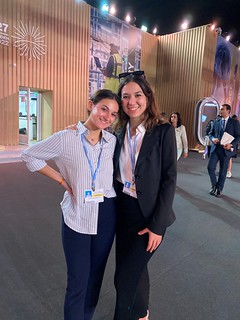 My hope for the future faltered originally on the very first day I attended the conference and listened to a panel about how corporations are resilient in the face of climate change. In this, there was simply no talk about the corporation’s plan for the future, or even what they’re currently doing to help reduce emissions and take part in the fight against climate change. Instead, all the speaker said were empty words that had no real meaning that fell along the lines of ‘we need to de-risk a small solution’ and that we must be ‘resilience multipliers,’ but what does that actually look like? What does that really mean? I remember being baffled at how little depth there was to the presentation, and walked out wondering if this was what the entirety of the COP27 discussions would be like. Thankfully, for the Earth and my sanity, it was not.
Unfortunately, though, the second day followed along a similar path. I attended the Emissions Gap Report, hosted by Inger Andersen, Executive Director of the United Nations Environment Program, and Simon Stiell, Executive Secretary of UNFCCC. During this report, they spoke about how critical it is for us to reduce emissions by 30-40% by 2030, as this will be one of the only ways we prevent irreversible change to our Earth and climate. However, they followed this information with the fact that while this reduction in emissions goal has been set for the past ~10 years, we have only reduced emissions by 1% and we are currently on track for a warming of 2.8°C. I quoted Stiell saying that we are currently at 1.1°C, and many are already “in living hell” as a result. This reality hit me like a truck, that while it may seem as though the world is doing something to try and fix our climate issues, like hosting conferences, it really is not as productive as many may think. What really stood out to me, though, was the lack of humanity in the reporting of these devastating facts. As Inger said we have only reduced emissions by 1%, and as Chief Scientific Editor of the Emissions Gap Report 2022, Annie Olhoff, stated that we are on set to reach a warming of about 2.8°C, there did not seem to be any sort of falter or fear in their voices. It felt as though this information was nothing new to them, and at this point they seemed as though numb to it. What I want to bring back to UConn and share with my fellow students, friends and really anyone that will listen, is the humanity to this discussion. These are not just numbers that will someday a few years down the line maybe impact us. These are already impacting us. I listened to a representative for Pakistan speak about how ⅓ of his country is currently underwater, 8 million houses are destroyed, and there are millions of people living on the streets because of catastrophic weather events brought on by climate change. Disastrous events are already happening, and they will only get worse. We need to bring a sense of urgency back into the discussion because it is so much more than a simple worry for the future.
I know it may be hard to come back from hearing that, but I do want to shed some light on the more positive discussions I sat in on that made me feel as though not all hope is lost. On the second to last day of the conference, which was dubbed “Solutions Day,” I attended a discussion called 1,000+ Clean Solutions to COP27. In this, a handbook called the Solutions Guide for Cities Booklet was presented, which contained 1,450 solutions to climate change and emissions. Not only were they just solutions, they were companies that have researched and are currently implementing these solutions – and they’re working! For example, the CEO of Turbulent Hydro discussed what his company has been doing. Basically, they put turbines into waterways that create whirlpools within the water, which then turns the moving water into electricity, and provides energy to anywhere between 60 – 350 houses. They currently have 25 turbines working in 13 different countries, getting clean energy to houses without the use of fossil fuels. A second solution that was presented was by the VP of Sustainability at a company called UBQ Materials. This company takes waste that cannot be recycled and turns it into plastic and wood substitutes. The point was even made that UBQ Materials could have created all of the buildings Egypt had put up to hold the conference out of waste, using items that otherwise would have ended up in a landfill. This was the discussion that when leaving, made me feel extremely inspired and gave me hope for a future. There are people that are devoting their lives to helping combat climate change, and the number of those people is only increasing.
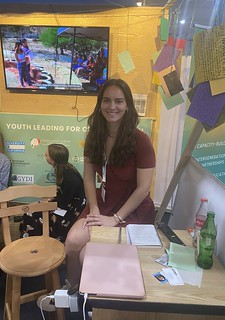
 After my initial frustrations about not being able to contribute to international agreements, I realized change does not have to come about in such extravagant gestures. While the COP was a place for parties to meet internationally, it was also a place to share smaller successes that can be duplicated throughout local communities. I witnessed how youth were being involved in various spheres which made the problem of climate change not seem so daunting. Throughout my time at UConn I have been so focused on policy as the way to solve the climate crisis. What COP has put into perspective for me is that policy may be written and implemented by policy makers, but it is the attitude of the people that shape it. One way to shift such attitudes and accelerate the inclusion of new perspectives is through youth involvement and education. When kids can grow up learning about, experiencing and understanding our planet there is greater room for change. I always told myself I wouldn’t go into education. But I have since seen how influential my role in educating generations even beyond mine could be. Climate change is a crisis that my generation has inherited from generations before mine that did not deal with it. It is inevitable that the generations that come after mine will inherit the crisis however we choose to deal with it (or not). Climate change most likely won’t be solved in the next 30 years and even if it is, the Earth needs time to heal. One thing I hope I can do is leave the next generation with the adequate tools to continue on the work my peers and I are doing today. While this isn’t a path for myself that I have explored indepth, my time at COP has contributed to this new avenue.
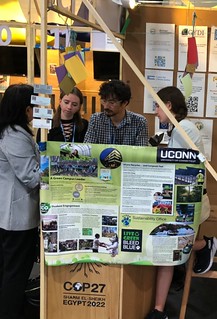 COP27 was one of the most meaningful weeks of my life. Full of dynamic challenges, I feel my worldview of climate change vastly evolved and broadened. COP27’s goals were to implement policies on adaptation and mitigation and loss and damages: two concepts I only tangentially worked with. I realized the importance of these missions when I heard this quote at the Ocean Alliance pavilion: “conservation without funding is just conversation.” Spending so much of my time at UConn connecting with the land, I feel I dismissed the financial aspect of climate change. It seemed unimportant when I could listen to the trees and the animals. But hearing the cries from people for the implementation of loss and damages, awakened me to the importance of finance. I attended a panel discussing financial changes since the adoption of the Glasgow Pledge during COP26. It was a contrasting panel: people from the global south passionately and desperately asking for progress at this COP and people from the global north indifferently talking about frivolous roadblocks to reparations and justice. So distributing that funding is immensely important to conservation work. Without that action, we are simply engaging in tedious conversations that don’t further climate policy whatsoever. COP27 opened my world to a whole new sector of sustainability.
 My time in Sharm El-Sheikh was a display of the progress made in the fight for climate justice, but a sobering reality of how much further we have to go. I came to the conference with a desire to see ardent talks making monumental progress, but I was faced with stolid negotiations focused on the minutiae rather than tangible, large-scale solutions. Everytime I sought progress, I was met with compromise. Perhaps the zenith of COP27 was the announcement of a “Loss and Damage” fund intended to assist those countries most affected by climate change. Yet, there is no clear indication of who will pay into the fund, where the money will come from, or who will benefit.
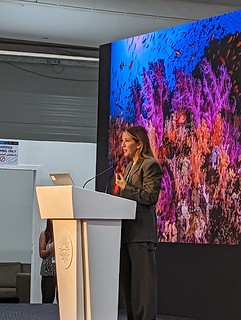 Sharm-el-Sheikh, the location of COP27, is a coastal Egyptian resort town that is adjacent to the Great Fringing Reef. Located in the cooler waters of the Red Sea, this reef is one of the most resilient reefs in the world; it is no surprise that COP27 publicity and advertisements repeatedly featured images and videos of the beautiful and vibrant underwater world. On one panel, “Hope For Coral Reefs,” singer-songwriter Ellie Goulding praised the reef’s “sheer visual beauty” and encouraged the audience to “please experience this reef yourself.” Yet at a conference where activisists and negotiators are working long days– and sometimes overnight– there seemed to be little time left to enjoy the beauty of nature.
 At the same time, it is important to recognize the privilege and responsibility that comes with being able to attend COP27. Very few people have the opportunity to travel to the conference, and it is especially rare to be able to do so as a student. To have spent a week in a hotel along the coast of the Red Sea was amazing, with that luxury in juxtaposition with many of the stories told by activists from communities where significant impacts from climate change are already being felt. However, I also believe that the coming together of activists, politicians, negotiators, citizens, and indigenous peoples from around the world in one place is invaluable, and that finding joy in the world around us is necessary to sustaining activism. Particularly as frustratingly little progress was made on reaching a 1.5 degree warming target, it is important to take time to reset for the continued fight for a more equitable and sustainable future.
 Winning a monumental court case should feel incredible, right? The opposite was true for Luisa Neubauer, the plaintiff in