
This year, the 2024 United Nations Climate Change Conference (COP29) has the power to do something exceptional. With stakeholders, negotiators, and observers from across the world in attendance (including myself), this should be a special moment to focus on the issues that matter most. COP29 has been referred to as the “finance COP” due to its significance in readdressing the financial obligations of all parties involved. While this event occurs annually, this conference specifically plays a critical role in geopolitical financial responsibilities for years to come.
With this in mind, I journeyed through the Blue Zone at Baku Stadium in Azerbaijan, the host location for this year’s conference. This event is traditionally split between two sections, both the Green and Blue Zones. As of this writing, I have only explored the Blue Zone, which serves as the venue for formal negotiations, panels, and pavilion events. The Green Zone, from what I have heard, offers a more interactive experience with activity hubs and side panels featuring various stakeholders.
My week began on Monday, November 18, observing official proceedings in the Plenary Hall. The most impactful moment of COP29 so far came during the very first event I attended. Attorney General Graham Leung of Fiji delivered a passionate address, stating: “On finance ambition, let me emphasize again that an ambitious outcome must focus not only on how much but also on how the finance will flow.” (FBC News) His concern highlighted a pressing issue: many parties to existing global climate agreements, such as the Paris Climate Agreement, have yet to pay their fair share of the commitment. Even among those who have contributed, questions remain about whether these contributions are leading in the correct direction — both in terms of communities and industries. Leung called for strong financial provisions and a minimum threshold to ensure fair and effective resource allocation for loss, damage, and adaptation efforts.
It is undeniably true that some countries have sought to exploit the principles of the Paris Climate Agreement, including their Nationally Determined Contributions (NDCs). During a Sustainable Transport panel at the Canadian Pavilion, it was revealed that certain nations have focused on building more roads to score points toward meeting their NDCs, while neglecting critical investments in public transportation infrastructure.
This was the prevailing theme on my first day — parties voicing dissatisfaction with the efforts of others. Informally, Monday seemed dominated by a “blame game” atmosphere. This was no surprise as world leaders spent their days during the world summit last week, antagonizing and throwing blame across the world stage of who was responsible rather than offering solutions. What should also not go unnoticed is the fact that many countries who are here are the ones accountable for the mess that we find ourselves in.

Major oil-producing countries, such as Qatar, Saudi Arabia, Oman, the United Arab Emirates, Kuwait, etc, all have a larger-than-expected presence at this summit. Most have glamorous and extravagant pavilion locations, dishing out free food to all who would like, attempting to greenwash their history when it comes to oil production. Let it be known that we are not perfect either. Both the United States as well as China face their own hypocrisy on the world stage, championing climate solutions while being among the biggest contributors to the problem. To objectively view these talks, it is essential to approach them with an awareness of this underlying hypocrisy and complexity.
COP29 has not been as grim as I initially made it out to be. On Tuesday, November 19, and Wednesday, November 20, I drew on my first-day experiences to better prepare for reentering the Blue Zone. I knew that I actively enjoyed the pavilions as parties were tasked with managing their own panels. Building on that understanding, I attended the British Pavilion event on Active Transport. One striking fact from the panel was that every dollar invested in public transportation yields a $5 return on investment. The discussion focused on strategies to promote sustainable transit initiatives to local communities. During the event, I had the opportunity to meet British Member of Parliament (MP) Mary Creagh who was also the Parliamentary Under-Secretary of State for Nature. She gave me some of the most important advice I could have received at this point in my life. As a Planning and Zoning Commissioner in my hometown of South Windsor, CT, promoting urbanist principles can sometimes be a challenging endeavor. I asked her for insights on achieving breakthroughs, and she emphasized the importance of empathetic leadership and storytelling to persuade stakeholders and drive progress. Her guidance could not have come at a better time in my journey.
If you were to ask me for my takeaway from COP29 so far with what remains, I would say to be critical but ambitious about what is possible. The majority of attendees understand the setting we are all in. Every COP cannot be a landmark oasis of agreements and principles. Yet, each conference holds the potential to lay crucial groundwork, build momentum, and inspire the bold actions needed to address our shared climate crisis.
Alan Cavagnaro is a Political Science and Urban and Community Studies major in the College of Liberal Arts and Sciences.
 COP29 is a true hodgepodge of information from countries, indigenous populations, corporations, nonprofits, and all the way down to the individual level. There has been a swarm of information from every corner of the climate crisis and from every stakeholder involved. On Monday, November 18, I attended the Green Zone, a less restrictive and more open space that featured the lived experiences of climate activists and panels on youth presence and solutions in the climate space. On Tuesday, November 19, I attended the Blue Zone, a more expansive area that features both closed and open negotiations, press conferences, and direct interaction with delegations, with the day focusing on food, agriculture, and water. Both zones showed that this conference is about spreading information and how we, as observers, engage with it.

 Attending COP29 as a young college student, it’s easy to get swept up in the negative rhetoric surrounding the conference. Criticisms abound, whether it’s the choice of Azerbaijan as the host—a major oil-producing country with a contentious human rights record—or the constant media headlines questioning the efficacy of the event: “Should We Get Rid of COP?” or “Climate Negotiations Going Nowhere.” Concerns about private sector involvement, from corporate pavilions to lobbying efforts, add fuel to the skepticism. But here’s the thing: focusing solely on the negatives doesn’t move us forward. Criticism is important for progress, and institutions like COP must be held accountable. However, dwelling on flaws without working towards solutions, risks derailing the very goals the conference aims to achieve. Over the first two days in the Green Zone, I’ve encountered a more nuanced perspective—one that prioritizes collaboration over condemnation.

 My experience at COP29 thus far has been eye opening. I have attended a variety of panels, events, and networking sessions that have allowed me to learn more about a variety of environmental issues, meet and talk to students and professionals from across the globe, and better understand the efforts being made by countries to address the climate crisis.


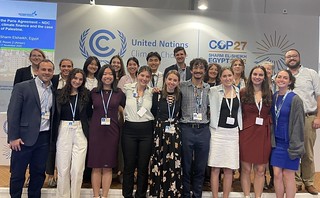 As I reflect on my experience attending COP27, there are several key takeaways I would like to discuss. My first takeaway is that I believe this experience is invaluable for both UConn graduate and undergraduate students and provides a transformative real-world component to their experience at UConn. Specifically, the UConn@COP Fellowship Program provides students direct exposure to learn about international policy negotiations, network with diplomats and business leaders, and connect with people from cultures around the world at an unparalleled scale. In 1995, COP1 had just under 4,000 attendees but this number has continued to swell with almost 50,000 attendees at COP27 making it by far the largest diplomatic gathering on earth. The scale of this conference reflects the overwhelming consensus by over 190 countries for the need to address climate change and the tremendous opportunity for students to derive value from attending this event as a springboard for professional development.