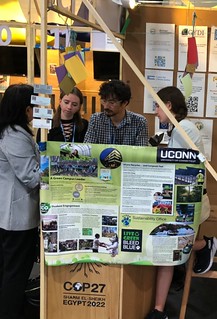
 COP27 was one of the most meaningful weeks of my life. Full of dynamic challenges, I feel my worldview of climate change vastly evolved and broadened. COP27’s goals were to implement policies on adaptation and mitigation and loss and damages: two concepts I only tangentially worked with. I realized the importance of these missions when I heard this quote at the Ocean Alliance pavilion: “conservation without funding is just conversation.” Spending so much of my time at UConn connecting with the land, I feel I dismissed the financial aspect of climate change. It seemed unimportant when I could listen to the trees and the animals. But hearing the cries from people for the implementation of loss and damages, awakened me to the importance of finance. I attended a panel discussing financial changes since the adoption of the Glasgow Pledge during COP26. It was a contrasting panel: people from the global south passionately and desperately asking for progress at this COP and people from the global north indifferently talking about frivolous roadblocks to reparations and justice. So distributing that funding is immensely important to conservation work. Without that action, we are simply engaging in tedious conversations that don’t further climate policy whatsoever. COP27 opened my world to a whole new sector of sustainability.
Alternatively, it expanded my perspective on a sector I thought I understood. At UConn, I help submit the greenhouse gas inventory. I collect data from the university’s departments on emissions and then submit those statistics to an online platform that pulls it all together into a coherent distribution. I had the privilege of attending a panel on the Emissions Gap Report 2022 at COP27. The report looks at humanity’s current emissions relative to where we should be based on the promises of the 2015 Paris Climate Agreement. In the context of my work, I found their report to be innovative and inspiring. The collective intellect of the group yielded a holistic report that is used as a foundation for so much climate policy and activism – you have to appreciate its ingenuity and utility in the emerging world. But a quote from the panel set in the gravity of our situation: “The reality is that we are currently in a 1.12°C warmer world and it is already a living hell for many communities.” Reconciling my appreciation for the numerical analysis of climate change with my understanding of climate change as a human rights crisis is something I haven’t confronted to this point. Academia can be somewhat isolating, I think. It can feel theoretical reading about the climate crisis, and I think as a result, a sort of naivety developed with regards to climate change. So, it makes sense that my undergraduate degrees (Mathematics and Environmental Science) have felt separate. Moving forward, my task is to marry these two to strengthen my environmentalism.
I think I’ll use the words of author Chimamanda Ngozi Adichie to capture my closing feelings after COP27: there is no single story on climate change. To buy into this narrative of doom and guilt is unfair to all the meaningful climate work done by people like those at COP. It erases their stories and discourages others from ever wanting to improve the world. Of course, climate work is upsetting. I sobbed multiple times throughout the week and had to excuse myself from the room. It means I have empathy: that I understand this is a living nightmare for our plant friends, our animal friends, and of course, our human friends. But to let those feelings consume yields nothing. Instead, I feel a buoyancy I didn’t possess before the conference. COP27 was a further call to action for me. I will always devote myself to helping the plants, the animals, and my fellow humans. I care for the Earth, and I know it does the same for me.
 My time in Sharm El-Sheikh was a display of the progress made in the fight for climate justice, but a sobering reality of how much further we have to go. I came to the conference with a desire to see ardent talks making monumental progress, but I was faced with stolid negotiations focused on the minutiae rather than tangible, large-scale solutions. Everytime I sought progress, I was met with compromise. Perhaps the zenith of COP27 was the announcement of a “Loss and Damage” fund intended to assist those countries most affected by climate change. Yet, there is no clear indication of who will pay into the fund, where the money will come from, or who will benefit.
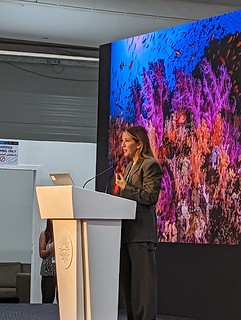 Sharm-el-Sheikh, the location of COP27, is a coastal Egyptian resort town that is adjacent to the Great Fringing Reef. Located in the cooler waters of the Red Sea, this reef is one of the most resilient reefs in the world; it is no surprise that COP27 publicity and advertisements repeatedly featured images and videos of the beautiful and vibrant underwater world. On one panel, “Hope For Coral Reefs,” singer-songwriter Ellie Goulding praised the reef’s “sheer visual beauty” and encouraged the audience to “please experience this reef yourself.” Yet at a conference where activisists and negotiators are working long days– and sometimes overnight– there seemed to be little time left to enjoy the beauty of nature.
 At the same time, it is important to recognize the privilege and responsibility that comes with being able to attend COP27. Very few people have the opportunity to travel to the conference, and it is especially rare to be able to do so as a student. To have spent a week in a hotel along the coast of the Red Sea was amazing, with that luxury in juxtaposition with many of the stories told by activists from communities where significant impacts from climate change are already being felt. However, I also believe that the coming together of activists, politicians, negotiators, citizens, and indigenous peoples from around the world in one place is invaluable, and that finding joy in the world around us is necessary to sustaining activism. Particularly as frustratingly little progress was made on reaching a 1.5 degree warming target, it is important to take time to reset for the continued fight for a more equitable and sustainable future.
 Winning a monumental court case should feel incredible, right? The opposite was true for Luisa Neubauer, the plaintiff in
