COP27 has been one of the most overwhelming yet formative experiences of my life thus far. Meeting some of the most influential activists, community organizers, and politicians has been humbling and enlightening. I have met various people who have left me in tears including Ms. Elizabeth Wathuli. During my very first panel at COP, she spoke about the disproportionate effects that women feel from the climate crisis and about her work in Nairobi, Kenya where women dig wells so deep that they get buried alive due to sediment collapse. I have tried to be a sponge, absorbing the knowledge that all these professionals have, especially as it pertains to clean, renewable energy since that is where I believe my career interests lay. Getting to exchange contact information with people like Ms. Ann Ohloff, the chief scientific editor of the Emission Gap Report, and Louise Burrows, an Energy Advisor for E3G’s Coal Transition team, feels surreal and as I write this blog, this very much feels like a fever dream. I am beyond grateful to be in this space and I feel that with every panel I change my perspectives and grow as a young climate activist.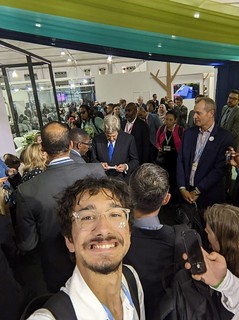
However, I have noted a distinct lack of queer representation at COP27. Many (not all) panels show a diversity of gender, race, and background yet noticeably, there is no discussion about queer people existing in these spaces. I come from a Women’s, Gender, and Sexuality Studies background so I feel keenly aware of how LGBTQ+ people occupy spaces and feel comfortable to express themselves in these spaces. To say I am disappointed is somewhat of an understatement. There is so much wisdom here at COP at the variety of panels and events which tells us that diversity strengthens humanity and climate resilience as a whole. So to see a whole group of people ignored and made invisible feels disenfranchising.
This is when I feel thankful to be a UConn student. This cohort of young undergraduates and graduates makes me feel hope when we begin each day with stimulating and engaging ‘Breakfast Talks’ where we discuss our thoughts and feelings about the conference. All the fellows come from a variety of backgrounds and throughout the day we all venture into different panels and learn such a plethora of knowledge. During our morning ‘Breakfast Club’ I find the points of views expand my knowledge of COP27 and give me greater agency to squeeze every ounce out of the conference. I am excited for solutions day tomorrow. Climate activism can be heavy and discouraging so it is important to embrace these solutions and recognize that any change is positive change.


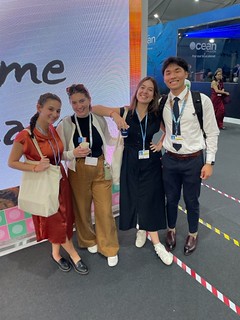
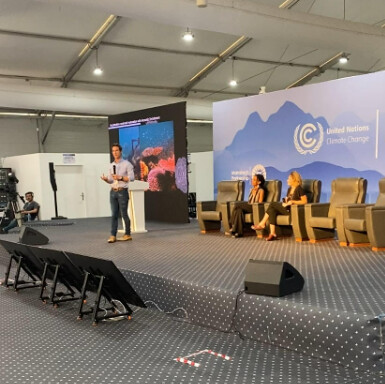
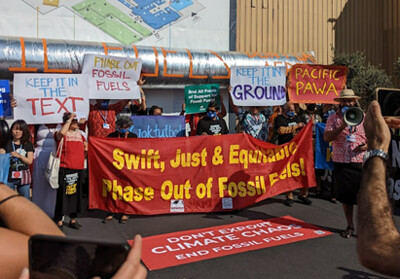 This past Tuesday, our cohort attended an event presenting on the Emission Gap Report by the United Nations (UN). This report provides an updated assessment on the gap between our current global greenhouse gas (GHG) emissions and our goals for 2030 to limit the global temperature below 1.5 degree Celsius. This is necessary to minimize the most significant harm from climate change as determined by the Paris Agreement of 2015.
 Before my arrival at COP27, I had a dream that I could open any book, jump into its pages and be immersed in its story. I woke up imagining all the stories I would want to live. But simultaneously I thought of the stories I would not want to experience. These are the ones that frightened me or made me feel anxious, alone, helpless.
 One of the most impactful experiences I have had as an observer at COP27 occurred at a small pavilion hosted by an NGO. I wasn’t initially planning on stopping by the pavilion, but a representative saw me walking by and asked if I would be interested in participating in a small group discussion with other COP27 participants. Often, many of the country negotiators (the ones actually writing and reforming policy) are noticeably absent from the bustle of the pavilions and panel discussions. Instead, these spaces are usually filled with activists, organization members, or observers, while negotiators tend to stick to meeting rooms and work offices. I was therefore surprised when I joined the small group– in addition to organization members and observers, I was sitting next to negotiators from France, South Sudan, and Yemen.
 After three days of the conference, I am still in disbelief that I have the privilege to be in Sharm el-Sheikh, Egypt for COP27. Expanding my knowledge on climate change started on the bus to the JFK airport, in discussions with my peers about their perspectives on clean and renewable energy, Indigenous approaches to climate action and more. Intellectually I am attempting to absorb as much information as I can on everything that I am interested in or know nothing about. It has been an emotional rollercoaster going from being overwhelmed by the breadth and depth of climate change, to realizing that heartbreak for the destruction of life on our planet is the reason we are drawn here (Professor Phoebe Godfrey said it best), to contemplating my role in climate action, and to gaining hope for our future from all the technology, knowledge, innovations, art, poetry, and passions showcased at the conference. Each day I wish I could be at multiple places at one time and jot down everything I am learning. Every day I am humbled by how much I didn’t know about climate change and climate solutions.
 My experience at COP27 in Sharm El-Sheikh has been a whirlwind so far, often overwhelming at times in its scale and scope. The multitudes of people who traveled from every corner of the earth to share their stories of how their livelihoods are being impacted by climate change adds more gravity, reality, and clarity to the situation than ever before. On the bus ride back from the conference tonight, I sat next to a woman from the party delegation representing the pacific island nation of Vanuatu who told me of the stark impacts of climate change and associated sea level rise which have caused salt-water intrusion on their country’s water supplies, forced a school near the coastline to be abandoned, reduced agricultural productivity, and degraded coral reefs and fisheries. She told me that many other small pacific island nations are facing similar challenges that are expected to worsen.
 As climate activists, it is far too easy to succumb to cynicism and accept that change will never come. In a series of panels titled “Futures Lab: Reconfiguring the Law for a Net Zero Future,” I unlearned some misconceptions, releasing my anxieties about the climate crisis and feeling more fulfilled by COP27 in the process. Georgina Beasley, the Secretary General of the Net-Zero Lawyers Alliance, told us to imagine a stack of cards, each symbolizing one field of law. She urged us to understand the value of our “card” and the impact of the advice lawyers provide to corporations and state agencies. By refusing to play the hand we are dealt, we can shift the dial of legal frameworks and unlock greater ambitions. Civil society has a hand in environmental, social governance. As citizens in both developing and developed nations, we must cooperate to fund losses and damages. Similarly, we must hold each other accountable for achieving the Sustainable Development Goals and honoring our commitments to other countries.