Published in UConn Today on 12.23.2022:
UConn recognized as a top-performing institution by the Sustainability, Tracking, Assessment & Rating System (STARS) and UI GreenMetric World University Rankings.
UConn continues to lead sustainability in higher education. The Sustainable Campus Index tracks universities’ efforts to improve performance in 17 sustainability impact areas, measured by STARS. This year, UConn was ranked 6th overall. The STARS process helps institutions all over the world measure, report and strengthen their contributions to sustainability.
Besides being #6 overall, UConn has the distinction of being one of 12 STARS Platinum-rated schools out of 1,105 participating institutions. When digging into the 2022 ratings, UConn excelled in a few categories:
#1 – Campus Engagement: Providing co-curricular activities that allow students, faculty and staff to deepen their understanding of sustainability. These efforts help integrate sustainability into campus culture and encourage more eco-friendly behavior change.
#1 – Public Engagement: Working with community members, governments, businesses and nonprofits to foster solutions to sustainability challenges. Examples include partnerships, community service, and public policy participation.
#2 (tie) – Water: Conserving water, effectively managing rainwater, and protecting groundwater supplies. These efforts reduce energy usage and improve local water ecosystem health.
#4 – Food & Dining: Designing dining programs that support local farms, environmentally friendly farming methods, agricultural worker equity, and uphold sustainable food systems (e.g. meatless dining).
#7 – Curriculum: Equipping students with learning opportunities in sustainability, including courses, living laboratories, immersive experiences and sustainability literacy.
STARS, a program of The Association for the Advancement of Sustainability in Higher Education (AASHE), is a self-reporting system that measures colleges’ and universities’ performances in several aspects of sustainability.
The framework scores institutions in 17 different impact areas. These include air and climate, buildings, energy, research, and grounds. Schools that earn the greatest percentage of possible points for each area are named top performers.
UConn joined the international network of STARS institutions in 2013, when it was designated as a Reporter. The University then achieved Gold status in 2016, 2017, and 2018. It was rated Platinum for the first time in 2020.
Erin Lindsay ’23 (CLAS), a Senior Sustainability Intern at the UConn Office of Sustainability, is proud of the impressive ranking, but acknowledged there is still room for improvement.
“Participating in AASHE STARS gives our university the opportunity to be recognized within our community and beyond at the state and even national levels. We perform extremely well in areas related to student engagement and outreach which is a direct result of our incredible student body,” Lindsay says.
“With that being said, STARS also brings light to areas where we need more focus, especially at the institutional level,” she says. “We need greater emphasis on sustainable investments, especially those related to purchasing and energy in order to meet our campus-wide sustainability goals.”
UConn also ranked as the 2022 8th Most Sustainable University by the University of Indonesia’s GreenMetric World University Rankings program. GreenMetric measures 39 indicators in six criteria related to university environmental commitments and initiatives. Over 950 institutions participate across the globe.
Sustainability initiatives at the University contribute to its Platinum rating and top marks in GreenMetric. These include the EcoMadness conservation competition, UConn@COP program, and environmental literacy requirement. Learn more about UConn’s sustainability initiatives and goals at the Office of Sustainability website.
Head over to UConn Today to read the original story: https://today.uconn.edu/2022/12/uconn-ranked-in-top-10-most-sustainable-universities/
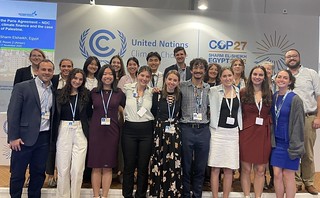 As I reflect on my experience attending COP27, there are several key takeaways I would like to discuss. My first takeaway is that I believe this experience is invaluable for both UConn graduate and undergraduate students and provides a transformative real-world component to their experience at UConn. Specifically, the UConn@COP Fellowship Program provides students direct exposure to learn about international policy negotiations, network with diplomats and business leaders, and connect with people from cultures around the world at an unparalleled scale. In 1995, COP1 had just under 4,000 attendees but this number has continued to swell with almost 50,000 attendees at COP27 making it by far the largest diplomatic gathering on earth. The scale of this conference reflects the overwhelming consensus by over 190 countries for the need to address climate change and the tremendous opportunity for students to derive value from attending this event as a springboard for professional development.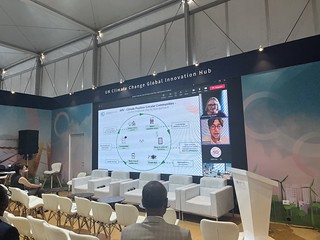
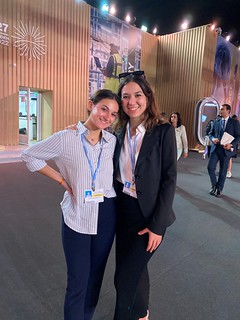 My hope for the future faltered originally on the very first day I attended the conference and listened to a panel about how corporations are resilient in the face of climate change. In this, there was simply no talk about the corporation’s plan for the future, or even what they’re currently doing to help reduce emissions and take part in the fight against climate change. Instead, all the speaker said were empty words that had no real meaning that fell along the lines of ‘we need to de-risk a small solution’ and that we must be ‘resilience multipliers,’ but what does that actually look like? What does that really mean? I remember being baffled at how little depth there was to the presentation, and walked out wondering if this was what the entirety of the COP27 discussions would be like. Thankfully, for the Earth and my sanity, it was not.
 After my initial frustrations about not being able to contribute to international agreements, I realized change does not have to come about in such extravagant gestures. While the COP was a place for parties to meet internationally, it was also a place to share smaller successes that can be duplicated throughout local communities. I witnessed how youth were being involved in various spheres which made the problem of climate change not seem so daunting. Throughout my time at UConn I have been so focused on policy as the way to solve the climate crisis. What COP has put into perspective for me is that policy may be written and implemented by policy makers, but it is the attitude of the people that shape it. One way to shift such attitudes and accelerate the inclusion of new perspectives is through youth involvement and education. When kids can grow up learning about, experiencing and understanding our planet there is greater room for change. I always told myself I wouldn’t go into education. But I have since seen how influential my role in educating generations even beyond mine could be. Climate change is a crisis that my generation has inherited from generations before mine that did not deal with it. It is inevitable that the generations that come after mine will inherit the crisis however we choose to deal with it (or not). Climate change most likely won’t be solved in the next 30 years and even if it is, the Earth needs time to heal. One thing I hope I can do is leave the next generation with the adequate tools to continue on the work my peers and I are doing today. While this isn’t a path for myself that I have explored indepth, my time at COP has contributed to this new avenue.
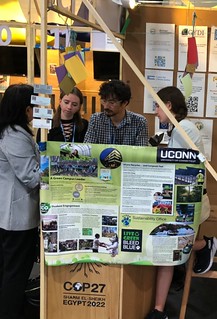 COP27 was one of the most meaningful weeks of my life. Full of dynamic challenges, I feel my worldview of climate change vastly evolved and broadened. COP27’s goals were to implement policies on adaptation and mitigation and loss and damages: two concepts I only tangentially worked with. I realized the importance of these missions when I heard this quote at the Ocean Alliance pavilion: “conservation without funding is just conversation.” Spending so much of my time at UConn connecting with the land, I feel I dismissed the financial aspect of climate change. It seemed unimportant when I could listen to the trees and the animals. But hearing the cries from people for the implementation of loss and damages, awakened me to the importance of finance. I attended a panel discussing financial changes since the adoption of the Glasgow Pledge during COP26. It was a contrasting panel: people from the global south passionately and desperately asking for progress at this COP and people from the global north indifferently talking about frivolous roadblocks to reparations and justice. So distributing that funding is immensely important to conservation work. Without that action, we are simply engaging in tedious conversations that don’t further climate policy whatsoever. COP27 opened my world to a whole new sector of sustainability.