Suhitha Sreedhar, Business Management Undergrad ’27
“Be the change you want to see in the world.” At COP, you meet the people who truly believe it. They’re passionate, frustrated, and hopeful, and they want action. They’re also sharing rooms with policymakers who aren’t always welcoming of that change.
One of our faculty leaders, Mark Urban, described climate as a knot, and those words have stuck with me all week. Climate can be viewed from so many angles, but the one that has taught me the most is how interconnected it all is: energy, water, land, technology, people, held in place by politics and the systems we’ve built. Pull one thread and the rest move with it.
The one concern within this space and also a conversation at COP that has caught my interest is AI and data centers.
On my first day, we attended a panel that talked about AI and data centers in the US. The four panelists had very different views. One, a California state senator, was clear that she’d do right by what her constituents want. Another believed data centers, AI or not, can’t be stopped, but that strong policy can regulate their misuse, and that the people building them must take far more responsibility than most enterprises do. The other two leaned pro-AI, one focused on using it positively, like reusing waste heat to warm water. In yet another panel, someone from Mississippi was quoted as saying, “we need better air to breathe and systems that help that, not another capital enterprise.”
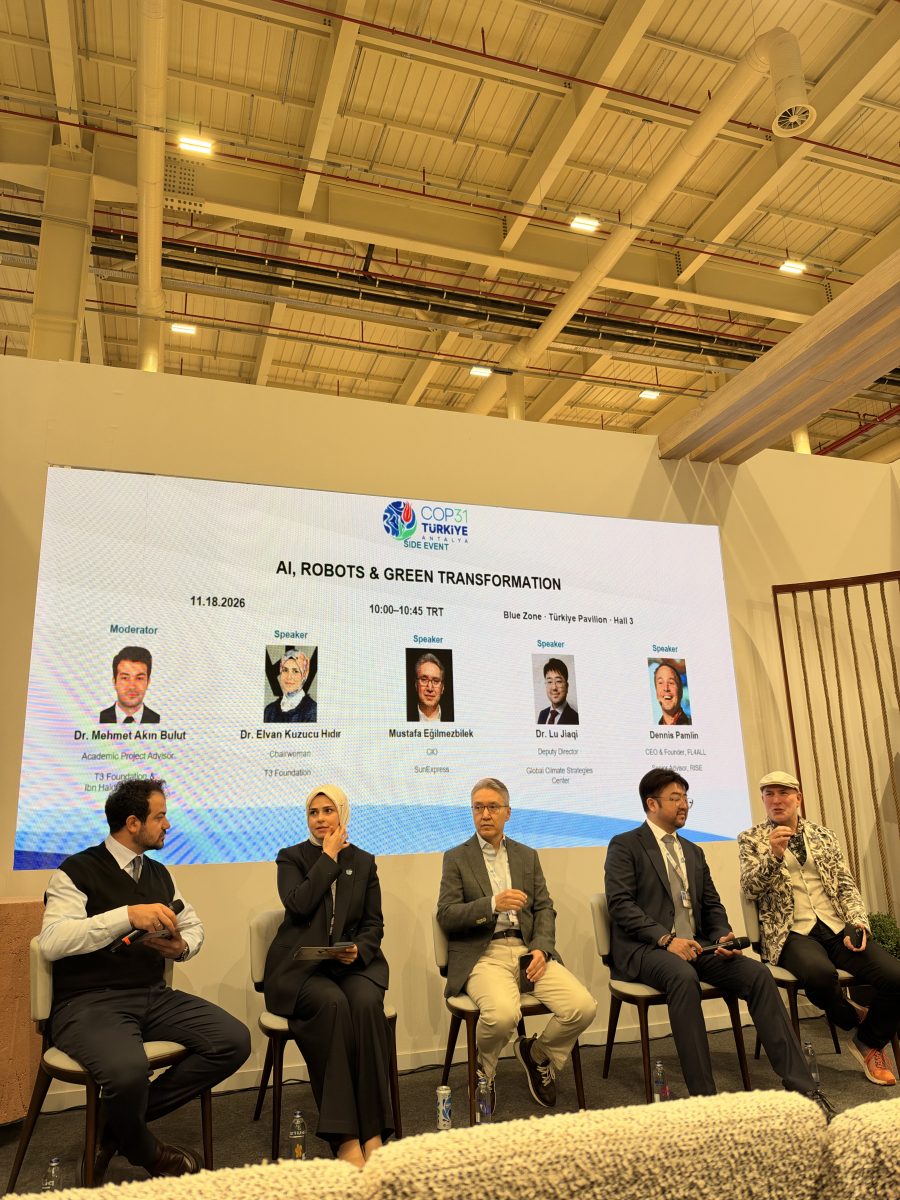 Then came the Türkiye Pavilion panel on “AI, robots and green transition.” A panelist said, “If you don’t use AI every day, you are foolish.” Disappointment and confusion flashed across my face, and I’m not sure anyone caught it. I’d hoped to hear how organizations are building more responsible data centers. Instead, we got a carbon-free future of drones and robots running on clean batteries, but nothing on where that energy is sourced and no measurable steps.
This topic has been circulating in our group, and I love those conversations. Ideas get thrown back and forth, more refined each time, almost like we’re solving the world. Here’s where I’m at right now. AI is already accelerating, and I don’t think it stops now. Whether the AI bubble bursts, I don’t know, so we have to think about the circularity and end of life of data centers: build them so that if they lose their purpose, they can serve another. Still, the phrase “good data center” doesn’t sit right with me. Right now, so much AI use feels unnecessary, like promotional social media posts, misinformation, and silly questions. I don’t want AI to replace human thinking, only to enhance it. It can do real good, like supporting underserved communities, or creating employment, but as one panelist said, creating jobs doesn’t justify the harm.
What I’m still reeling over is where. A UPenn professor that I met on the bus to COP mentioned talk of a data center complex as large as the I-95 corridor from New York to Washington. If that gets built, where does it go? Dr. Rachel Cleetus from the Union of Concerned Scientists, said data centers will be built where regulation is weakest, in places that can be manipulated or swayed by short-term employment gains. That hit close to home. In Visakhapatnam, Andhra Pradesh, in my own state, residents are protesting massive proposed AI data centers over water scarcity in a city already running a deficit, land acquired from local farmers and villages, and a lack of public consultation. The costs land on communities with the least power to say no.
Honestly, a lot of COP has felt conversational rather than action-oriented. With so much indecision among decision-makers, it can feel like the same unproductive meeting every year, and my fellow students and I are frustrated. But it’s been incredible exposure, and it’s reminded me that you have to be the change you want to see. I’ll keep digging into data centers, along with the policy and corporate sides of this.