UConn@COP30

Inside the Negotiation Rooms: A firsthand look at COP@30 Dynamics – Malak Nechnach

COP30 negotiations

Attending COP@30 has been a privilege; it has offered me the opportunity to engage with people from all over the world and hear diverse perspectives on climate solutions. The conference is well organized overall, though the usual delays in starting meetings were noticeable. With negotiations, side events, and pavilion talks happening simultaneously, it can quickly become overstimulating; however, I have already learned so much from the wide range of sessions I’ve attended.

The most meaningful part of COP@30 for me has been speaking directly with delegated and youth representatives. I had an amazing conversation with a student from the University of Oslo representing YOUNGO – the official children and youth constituency of the UNFCCC. We discussed pathways for youth involvement, and the types of actions young people have taken within the climate movement. I also had the opportunity to speak with members of both the French and Algerian delegation including Algerian negotiator Khaled Bassim with whom I discussed elements of the Sharm El-Sheikh Implementation Plan, which focuses on operationalizing funding for loss and damage, since there had been a new report about it posted the previous night.

Despite how valuable these conversations have been, the negotiations remain (in my opinion) the most interesting part of my experience. Negotiations take place in large rooms filled with country representatives, each attempting –often unsuccessfully- to reach a consensus. So far, two negotiations in particular have deeply shaped my understanding. The first was “Climate Change and Mountains” and the second one was “Special Needs and Circumstances of Africa”, which happened on Monday – my first day at the COP. This last session was intended to address four concrete agenda points outlined by the COP President, yet none of the points were discussed. As the delegate form the United Republic of Tanzania put it, the session devolved into a “vulnerability contest” between Africa versus the rest of the world. Countries such as Chile, Panama and Guatemala questioned why a meeting focused on Africa was necessary, arguing that many developing regions face equal levels of suffering. Most Latin American countries spoke in similar alignment under ILAc (Independent Alliance of Latin America and the Caribbeans). The delegates from South Africa and the African Group attempted –unsuccessfully- to bring the discussion back to the agenda reminding the room that despite contributing less than 4% of global emissions, Africa is both one of the least responsible and most vulnerable regions, projected to surpass the 1.5C threshold as early as 2040.

Malak in front of COP30 signIn response, one of the delegates argued that the meeting violated Article 4.8 of the Paris Agreement, which in my opinion was a complete misinterpretation. Article 4.8 emphasized equity and differentiated responsibilities, not uniform treatment under different circumstances. The entire meeting felt unproductive and at times, unprofessional, with several parties appearing to delay the conversation instead of contributing to it, which is why I am looking forward to reading the official written report of this meeting!

Overall, there are countless negotiations happening at all times. A lot of them are focused on specific paragraphs of previous agreements which are very interesting, but I especially enjoy the presidency-led meetings where the structure is clearer and discussions more focused.

Over the next few days, I plan to continue speaking with delegates from different countries, attend additional negotiations, and ask questions whenever possible. This experience has already expanded my understanding of international climate diplomacy, and I am excited to continue learning!

Malak Nechnach is a senior studying Physiology and Neurobiology with a minor in Mathematics.

Navigating the Noise at COP30 – Andy Zhang

Andy Zhang in front of China's COP30 pavilion.These past few days have been amazing! My first days were spent wandering around and feeling a little lost, but once I became familiar with the venue it was exciting to see all the different pavilions. It felt strange to walk through the space and see pavilions for China and India filled with activity, while the United States was essentially entirely absent despite being the largest historical emitter. Within several sessions, it felt frustrating because people talked in circles. The same phrases kept coming up, the same statements about urgency, the same calls to action. Yet it felt like no one wanted to put themselves on the line for the collective wellbeing for change to happen. I found myself wanting more honesty and more direction. It was hard to watch so many people speak passionately without feeling any movement toward concrete solutions. This experience also in many ways highlighted the larger paradox of global climate action. We need a coordinated global response to climate change, but it requires the willingness of countries to participate.

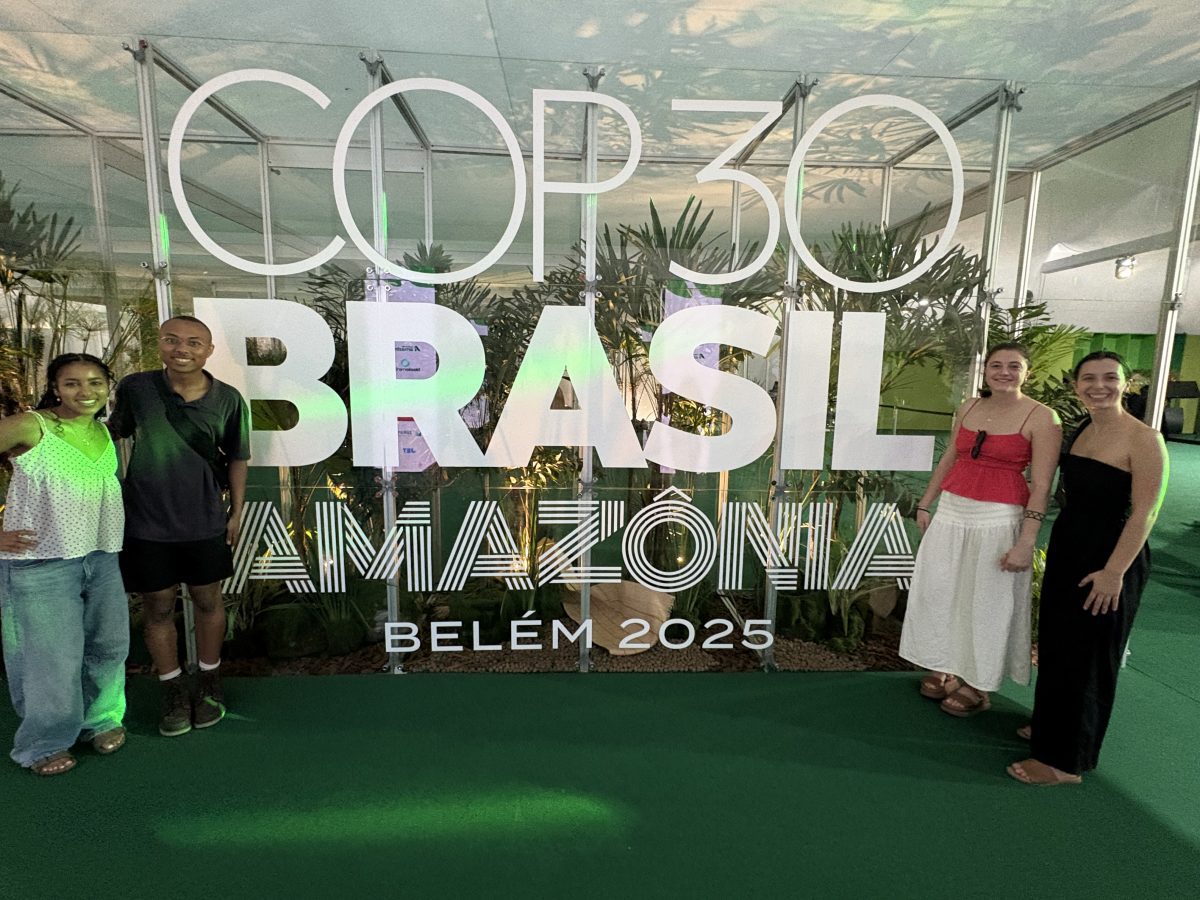
Students in front of COP30 Sign


Every nation needs Nationally Determined Contributions and climate goals, yet it must be left to each country to decide how to

 reach those goals because climate impacts differ so widely. This makes it incredibly difficult to come to a consensus when so many stakeholders have different needs, capacities, and responsibilities. Even with these challenges, I am excited for what is still ahead. I am looking forward to exploring more of the Blue Zone programming, attending sessions that focus on food systems and adaptation, and see how negotiators approach the later stages of discussions as COP starts to wind down. There is still so much to learn, and I am excited for the days to come. 

Andy Zhang is a senior studying environmental economics and environmental sciences.

The Debate of Women’s Rights at COP30 – Madelyn Kelly

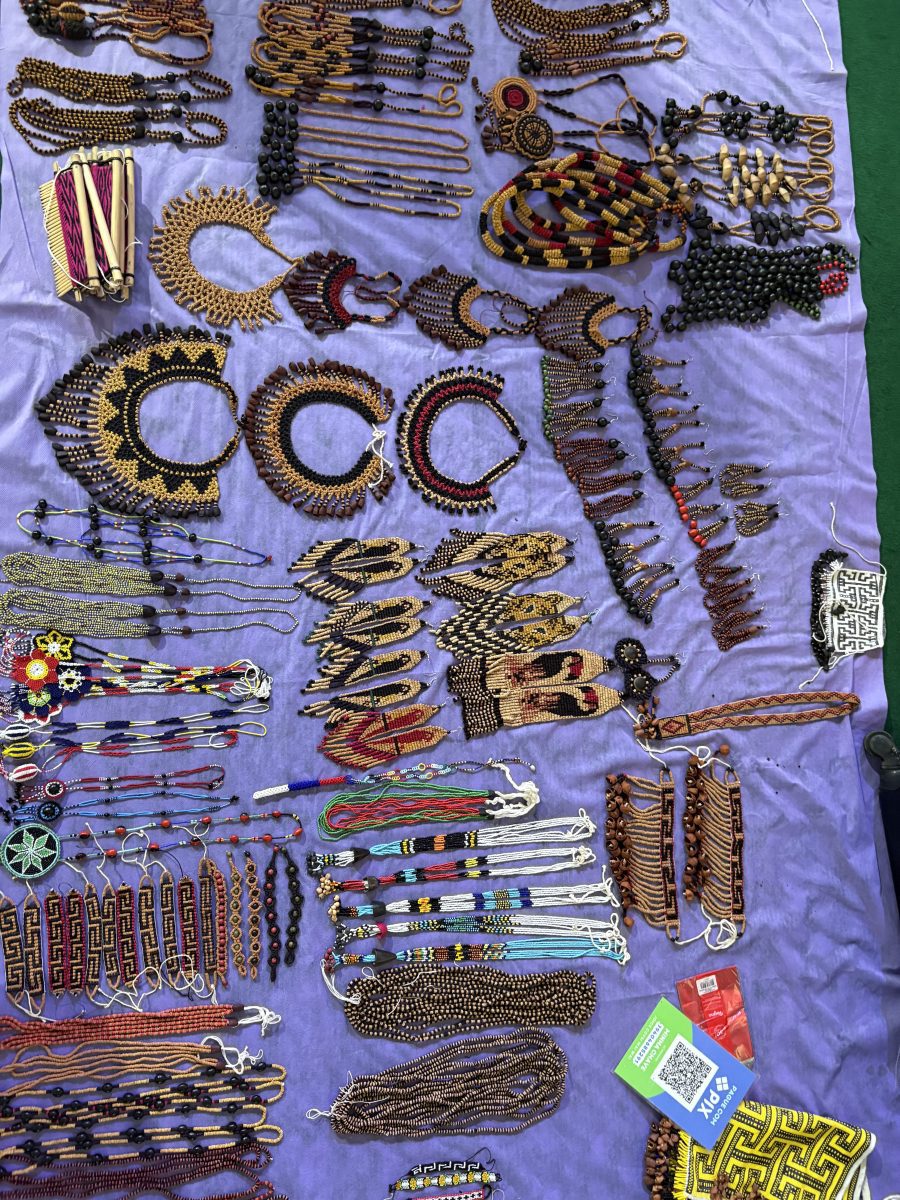
Beaded necklaces on a blanket.
Indigenous crafts for sale in the Green Zone.

Overwhelming is the first feeling that consumed me as I walked into the COP30 venue. Never have I been surrounded by such a diverse group of people and cultures.  It is hard for me to comprehend how delegates representing the over 190 UN countries present are peacefully existing under one (ENORMOUS) roof when their countries have historically had major conflicts.

While cordial, tensions were observed in the first policy discussion that I attended. This meeting was an informal session discussing the Policy and Strategy for Gender Equality and the Environment. I was disappointed to hear the lack of support for women’s equality and education in the language of the legislation document. The male Russian delegate requested that language be removed that required the equal representation of men and women in each country’s delegation. The male Iranian delegate backed this statement by saying that they do not have the resources to have equal representation of women in the delegation. Doubling down on this, both parties supported the change in wording from supporting/requiring “education” on gender and climate change to “training.” If education is not given to both men and women, then no, there will not be equal representation of men and women in the delegation (which extremely frustrated me). Additionally, the Saudi Arabian delegate, who was a woman, agreed with Russia and Iran and expressed disagreements with the advancement of women’s reproductive rights.

I know, I know, my first thoughts were also to be extremely upset and disappointed by these delegates (especially the woman), but I am not anymore. I cannot blame the individual delegates for statements that they may or may not support personally. Before this conference, I did not realize that delegates are given strict instructions on the stances they are allowed support. Deviating from the guidelines set by the higher levels of government could result in firing or more extreme measures in some countries.

Students in front of a COP30 sign.There is so much more I could go on about and so many valuable observations and pieces of information I have learned in the first 3 days I have spent at COP. I will quickly fire off some final thoughts (some inspiring and some discouraging) since landing in Belem: The culture in the Amazonia region of Brazil is deep and rich, the Indigenous Tribes in Brazil do not feel like their voices are getting proper representation in the conference, it is controversial that Brazil is advocating for Rainforest conversation while expanding oil drilling, it is crazy that international legislation is being written before my eyes, and how can any real action come from these “agreements” that are only enforceable by “peer pressure” and driven by economic benefits?

I am extremely grateful for this experience and cannot wait to explore these questions as I engage in COP for the next 2 days.

Madelyn Kelly is a senior environmental engineering student.


Stories From COP30 and What I Learned About Our Ocean – Anagha Payyambally

We wanted to begin COP30 not inside the venue, but by grounding ourselves in the culture, people, and nature of the region. That’s why our group travelled to Mocajuba, Pará, where we met the Amazon river dolphin, the boto, and spent time with local communities, learning about their traditions and enjoying their food. People spoke about the botos with pride, and it was easy to see why. These dolphins are incredibly intelligent and friendly with humans. One story that stayed with me was how they help fishermen by guiding them to fish-rich areas and even forming a boundary to trap the fish. Standing by the river, listening to stories from people who live with the forest and water every day, felt like the right way to enter a climate conference that tried to center local communities and their voices.Anagha Payyambally with an Amazonian dolphin.
My first day at COP30 took place in the Green Zone, where Indigenous communities stood at the center, wearing traditional outfits, selling handmade products, and filling the space with languages and knowledge systems that rarely receive global attention. Almost every event was in Portuguese, created for those who feel the weight of climate change first. It felt honest. It felt necessary.
When I moved into the Blue Zone for the following days, I focused on ocean-climate nexus talks, especially those addressing marine pollution, ecosystem losses, and ocean protection. Each session reminded me how fragile the ocean is and how fast we are losing time. One moment that stayed with me came from Brazilian sailor Torben Grael, a five-time Olympic medalist, who said that when he began sailing 50 years ago, he never saw plastic in the ocean. Today, he sees microplastics everywhere. The heaviness in his voice conveyed more than any graph or dataset.
Across the sessions, the call to protect 30 percent of the world’s oceans by 2030 was repeated again and again, echoing the UN’s Global Biodiversity Framework. The newly released Global Tipping Points report was another urgent highlight, especially its warning that coral reefs have crossed a threshold that may not be reversible. Panelists highlighted the need for a Global Coral Reef Summit in 2026 to rally the world around what remains.

COP30’s Oceans Special Envoy, Marinez Scherer.
Fellow Anagha with COP30’s Oceans Special Envoy, Marinez Scherer.

What moved me most at COP30 was the structure of the conversations in some of the sessions. Panels began with community voices, including Indigenous leaders and local people who rely on the land and ocean daily. They spoke about what they are seeing, what they are losing, and what they need. Government officials followed by outlining the actions they are taking now and the actions they can still pursue. It felt like real dialogue, like policy finally listening to lived experience. I also want to applaud the Brazilian government for what they modeled here. During my conversation with COP30’s Oceans Special Envoy, Marinez Scherer, she said that Brazil wanted to show the world what climate leadership looks like when biodiversity, Indigenous knowledge, and justice are treated as the foundation. She hopes Brazil’s approach inspires other nations to act with the same urgency.
Halfway through the conference, I realized something important: climate action doesn’t only happen in negotiation rooms. It begins in fishing villages, on riverbanks, and in the everyday knowledge of people whose lives are closely tied to nature.

Anagha Payyambally is a marine sciences graduate student.