 Before my arrival at COP27, I had a dream that I could open any book, jump into its pages and be immersed in its story. I woke up imagining all the stories I would want to live. But simultaneously I thought of the stories I would not want to experience. These are the ones that frightened me or made me feel anxious, alone, helpless.
It is during my past two days at COP27 where I have had the opportunity to jump into a glimpse of people’s stories from around the world surrounding climate change.
During my first encounter at the conference, I met Briony McDonaugh, a professor at the University of Hull. She described her research that studies the effectiveness of using storytelling to get communities to care and act on climate change. Her research has shown storytelling to be an incredibly effective tool when dealing with the climate crisis. This concept was fascinating to me and compelled me to seek out stories.
Later that day I attended Lalela uLwandle (Listen to the Sea): spiritual, cultural and scientific understandings of the oceans in a time of climate change. This was a play communicating the stories of coastal South African communities. The theater group described their process of collecting stories from real people affected by the destruction of the South African coast and sea. The actors’ emotion and the powerful contents of the play left me in tears and I was struck with such a powerful story.
The COP is a space for negotiations, politicians and world leaders, but I have found it is also a catalyst for storytelling. Such stories may not always be the ones we want to hear. But they are important and need to be amplified so that we may deal with this crisis at face value. At the “Global Farmer’s Market”, farmers from Puerto Rico, Cambodia, India and others shared stories of struggle; lack of financial support, lack of technology and a need to restart their farms every year when extreme weather and disaster strikes. I wonder if these stories lack the amplification for those in positions of power to hear. By this I don’t just mean world leaders, but also administrators, CEOs, local government and more. COP is somewhere when I have been able to hear such stories. It seems when I am at UConn, I am not forced to see the effects of climate change everyday. But here, people are sharing and communicating real life affects that threaten their livelihood.
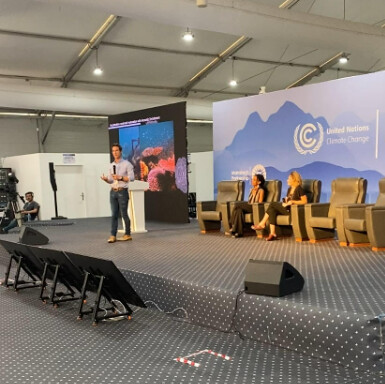
While there are many other stories heavy with fear and despair, there are also many stories of hope. Today – on my third day at COP – I heard a talk called “Google Arts: Calling in Our Corals” hosted by a team that developed research into a project for coral reef restoration. They explained their process of collecting underwater sounds from coral reefs in which they train people to acknowledge when they hear fish sounds in the recordings. This data is then used to program AI to do the same thing which is used to measure the health of the reef. What they found is that if they have a reef that is in need of restoration but lacks biodiversity, they can play the recording in an underwater speaker to attract the fish back to the reef to increase its biodiversity and thus its health. After the presentation I had the chance to speak with the head of the project. With confidence he said “I believe we will get through this climate crisis”. While only a small remark, it struck me as it can seem there is no progress being made. The pace of negotiations and frustration at the conference can make our future seem bleak. But is it with the story of hope that my presence at the conference seems worth it. There are so many people at COP that are here because they care about this crisis and it feels powerful to have them all congregated in one space.
As I have been able to jump into a variety of stories, I feel as if I am able to acquire new knowledge that I will be able to translate into my future work. It seems COP27 has allowed me to live out a dream in reality through voices of diverse storytelling. Yet still, as negotiations wrap up in these next few days, I wonder what will be the story of COP27? What will we look back on these past two weeks with triumph? Or wish we would have done more? Will our children and our children’s children be satisfied with the story we tell?
 One of the most impactful experiences I have had as an observer at COP27 occurred at a small pavilion hosted by an NGO. I wasn’t initially planning on stopping by the pavilion, but a representative saw me walking by and asked if I would be interested in participating in a small group discussion with other COP27 participants. Often, many of the country negotiators (the ones actually writing and reforming policy) are noticeably absent from the bustle of the pavilions and panel discussions. Instead, these spaces are usually filled with activists, organization members, or observers, while negotiators tend to stick to meeting rooms and work offices. I was therefore surprised when I joined the small group– in addition to organization members and observers, I was sitting next to negotiators from France, South Sudan, and Yemen.
 After three days of the conference, I am still in disbelief that I have the privilege to be in Sharm el-Sheikh, Egypt for COP27. Expanding my knowledge on climate change started on the bus to the JFK airport, in discussions with my peers about their perspectives on clean and renewable energy, Indigenous approaches to climate action and more. Intellectually I am attempting to absorb as much information as I can on everything that I am interested in or know nothing about. It has been an emotional rollercoaster going from being overwhelmed by the breadth and depth of climate change, to realizing that heartbreak for the destruction of life on our planet is the reason we are drawn here (Professor Phoebe Godfrey said it best), to contemplating my role in climate action, and to gaining hope for our future from all the technology, knowledge, innovations, art, poetry, and passions showcased at the conference. Each day I wish I could be at multiple places at one time and jot down everything I am learning. Every day I am humbled by how much I didn’t know about climate change and climate solutions.
 My experience at COP27 in Sharm El-Sheikh has been a whirlwind so far, often overwhelming at times in its scale and scope. The multitudes of people who traveled from every corner of the earth to share their stories of how their livelihoods are being impacted by climate change adds more gravity, reality, and clarity to the situation than ever before. On the bus ride back from the conference tonight, I sat next to a woman from the party delegation representing the pacific island nation of Vanuatu who told me of the stark impacts of climate change and associated sea level rise which have caused salt-water intrusion on their country’s water supplies, forced a school near the coastline to be abandoned, reduced agricultural productivity, and degraded coral reefs and fisheries. She told me that many other small pacific island nations are facing similar challenges that are expected to worsen.
 As climate activists, it is far too easy to succumb to cynicism and accept that change will never come. In a series of panels titled “Futures Lab: Reconfiguring the Law for a Net Zero Future,” I unlearned some misconceptions, releasing my anxieties about the climate crisis and feeling more fulfilled by COP27 in the process. Georgina Beasley, the Secretary General of the Net-Zero Lawyers Alliance, told us to imagine a stack of cards, each symbolizing one field of law. She urged us to understand the value of our “card” and the impact of the advice lawyers provide to corporations and state agencies. By refusing to play the hand we are dealt, we can shift the dial of legal frameworks and unlock greater ambitions. Civil society has a hand in environmental, social governance. As citizens in both developing and developed nations, we must cooperate to fund losses and damages. Similarly, we must hold each other accountable for achieving the Sustainable Development Goals and honoring our commitments to other countries.
 Attending COP27 has been the privilege of a lifetime. It is hard to put into words the sense of veneration that filled me when I found myself surrounded by politicians, activists, educators, and students all united by a genuine passion for climate justice. I came to the conference with the goal of learning how I could pursue a career in the healthcare sphere having gained a perspective on the environment’s role in human health. Like many others, I have always equated healthcare to medications, research innovations, and doctor visits. My experience at COP27 showed me how multidimensional health truly is, and emphasized how the climate crisis deteriorates it. Furthermore, I learned how the inequalities exacerbated by climate change are further amplified through health outcomes.
 As a student pursuing a dual degree in Ecology and Evolutionary Biology and Political Science on the pre-law track, I came into this conference with great excitement to witness firsthand the collaborative bridging of knowledge that will facilitate climate solutions. Paired with my love for the ocean and the beauty of its vast biodiversity, my academic path in ecology has primed me for the discussions at COP27 surrounding the detrimental impact of climate change on marine life. I strongly believe that the combined efforts of scientific and legislative expertise are imperative in not only achieving the UN’s net zero goals but other important environmental issues as well.

 The pace of global warming is accelerating. Impacts are coming faster and more furiously.