Month: December 2025

Language Lessons at COP30 – Saanya Sharma

Overall, COP 30 was one of the most overwhelming but beneficial experiences of my life. Going into the conference, you know there will be many countries represented, but you never truly grasp how influential this conference is to so many areas and people around the world. Each day, I was constantly meeting someone new who had a completely different background but was there for the same goal. Everyone was there to support the climate in one way or another, but many countries had interesting ways of showing it. One of the key lessons I learned from COP is how important it is to talk to people with different perspectives. I was given the opportunity to attend an ocean panel about how to address ocean acidification. During this panel, there was a variety of speakers from different backgrounds who brought such unique perspectives to the conversation. For example, I was able to hear viewpoints from policy, finance, research, and local community representatives all focused on the same topic. Hearing these perspectives enhanced my understanding and made me realize that many of the discussions that happen at COP 30 involve countless considerations.

This leads to the next key lesson I learned from COP: how important language is in the Paris Agreement. I attended a panel about gender and climate change where a document was being reviewed, and delegates from different countries could offer feedback on the revisions. Throughout this discussion, delegates constantly recommended changes they felt were necessary. At first, I had a hard time understanding how such a small change—like a comma—could make a significant difference to a policy or document, until I heard the explanations from the delegates. For example, in the original document, one of the phrases used was “local indigenous communities.” A delegate requested that there be a comma between “local” and “indigenous” because, without it, the language implied that the agenda item would only protect indigenous communities that are local, and not all indigenous communities. This is just one example of the many corrections and small changes in policy language that can have a major impact, and it was something I learned during this discussion.
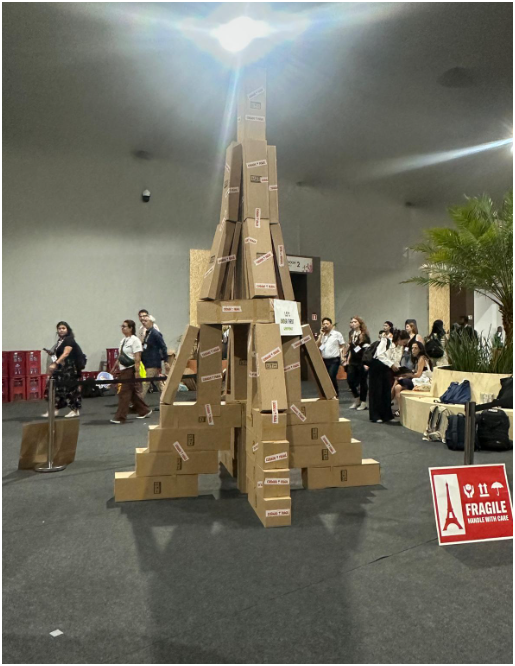
Eiffel Tower made of cardboard boxes with sign to Handle with CareOverall, based on the key lessons I learned from COP 30, I am very excited to apply them to my personal and professional life. One of the ways I am going to apply these lessons is in the remainder of my education. As an engineering major, it can be very easy to get stuck in a technical mindset and not focus on other perspectives when implementing solutions. Based on what I learned from COP 30, I hope to change that by bringing a more holistic mindset to my professional career—looking at solutions not just from a technical standpoint, but also considering policy, community impact, and finances. Another way I am going to apply what I learned about critical language is in my future efforts to make a positive contribution to climate action. I will be more careful and intentional with the language I use and how I present my knowledge to others. Overall, COP 30 opened a variety of doors and perspectives for me that I look forward to applying in both my personal and professional life.

Sanya Sharma is a senior environmental engineering major.
The Ocean’s Voice at COP30 – Anagha Payyambally

When I arrived in Belém for COP30, I expected climate negotiations, speeches, and long policy documents. I didn’t expect the ocean to be so present in so many conversations, especially because previous COPs rarely gave the ocean much attention.

As I listened to scientists, Indigenous leaders, and coastal communities during COP, I started to see the ocean not just as a research subject, but as a quiet hero holding the world together. As someone who studies the ocean, I’ve long known its importance in regulating our climate and sustaining life. The ocean absorbs 30% of all the carbon dioxide we emit, and 90% of the excess heat we create. It is our biggest climate buffer, working tirelessly and silently.

But the ocean is reaching its limit. In just ten years, it has warmed by 0.2°C, an unimaginable shift for marine life. Coral bleaching is no longer rare—it is at its peak. Ocean acidification is eating away at shells and ecosystems. Sea-level rise is threatening all coastal areas. People in the coastal communities talked about falling fish catches, stronger storms, and land lost to erosion. It became clear that a weakening ocean harms not only ecosystems but also economies, food security, and traditions. Still, the ocean has rarely been given real importance in climate talks.

This year’s COP gave me hope!

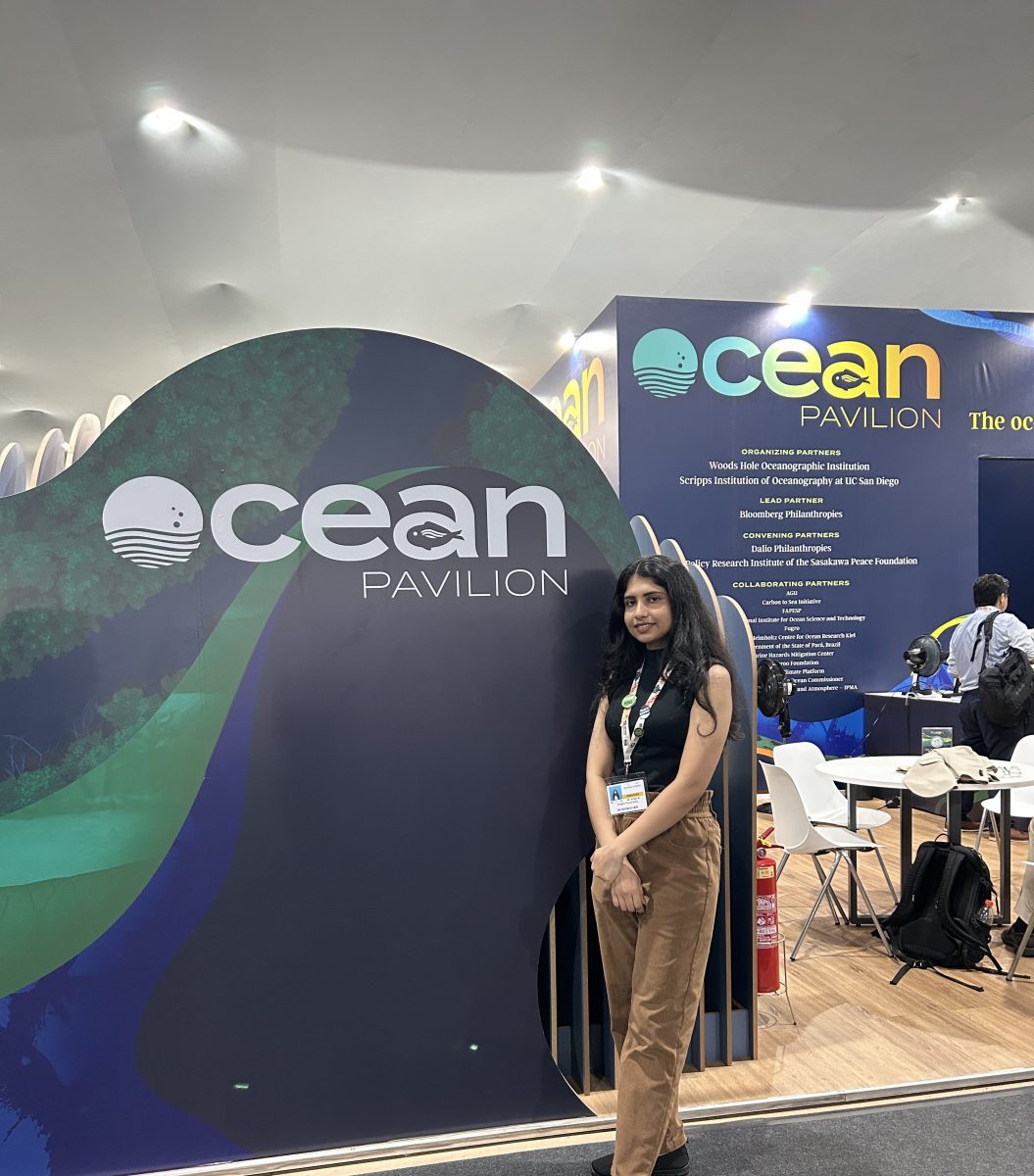
Anagha standing in front of COP30 Ocean PavilionFor the first time, there was a full Ocean Pavilion, not a tiny booth hidden in a corner, but a central, vibrant space filled with conversations that finally recognized the ocean as a climate powerhouse. I sat in panels where local communities, policymakers, and scientists spoke side by side, and I felt something shift. I hope the ocean is no longer an afterthought.

Countries also stepped up. Brazil and France launched a Blue NDC Taskforce to accelerate ocean-based climate action. Of the 66 coastal national climate plans submitted this year, 92% included ocean measures, a number that would have been unimaginable a few years ago. Brazil also introduced the Blue Package, offering technical guidance, finance pathways, and support for countries to include blue carbon, coastal resilience, and marine conservation in their next NDC updates. Ocean Breakthroughs was another milestone. This is a set of written science-based targets for marine renewables, conservation, shipping, tourism, and aquatic food systems. An online platform will track whether countries actually follow through, adding accountability to ambition.

And in one of the most hopeful moments, the High Seas Treaty reached 60 ratifications and is now set to enter into force in January 2026. Watching leaders celebrate this long-awaited achievement, I felt genuinely emotional. Brazil has even committed to ratifying the treaty before the end of the year. For the first time, the vast areas of our global ocean with no protection will finally have a chance.

But as I walked out of COP30 on the final day, I also felt a heaviness. Because even with all this progress, there is still so much more to do.

We can’t afford to wait; this is the moment for implementation. During one panel, a local community member was asked what he thinks about the future of the ocean. He answered, “In this situation, I don’t think about the future as tomorrow.” He and his community believe the future is today, and they are already taking steps to protect the ocean. I hope decision-makers and negotiators adopt this same mindset and act urgently to confront climate change and safeguard our ecosystems.

From the ocean-focused sessions I attended, I learned that we must create climate finance that truly includes the ocean. Right now, blue finance is less than 1% of global climate finance. We must prioritize coastal and island communities that contribute the least to climate change but bear the greatest impacts. We must make sure every country includes ocean solutions in their 2025 NDC updates. And we need to align policy, funding, and business so that protecting the ocean isn’t seen as charity, it’s seen as a smart economic strategy.

As a scientist, I came to COP chasing data and policy outcomes. But I am leaving with something else—an understanding that the ocean should not be just part of the climate conversation. It is the climate conversation. As a student who wants to communicate science beyond research papers, I will continue engaging in outreach with schools and local communities, helping people understand why the ocean matters for climate change and how even small actions can help protect it.

Now more than ever, the ocean needs our protection, and we need the ocean to shield us from the accelerating impacts of climate change.

Anagha Payyambally is a marine sciences graduate student.

COP30’s Importance is Not From the Negotiations – Caroline Keary

COP30 really solidified that climate change is not going anywhere and that we are wildly under prepared for the consequences of our actions. The fires and flooding venue were a strong reminder that we need to act however, the negotiations were a little fruitless. But, the knowledge and culture sharing was truly once in a lifetime. There is something wildly special about tens of thousands of people coming together and be unified in the fact that we want something to happen and are dedicated to change.

Beyond just the personal growth opportunities of learning how to communicate with people across every culture and learning the basics of how a conference is run. It was truly a once in a lifetime experience to go to a major city in Brazil with people from all over the world to see and understand how we can come together and implement the solutions to the problems we have been discussing. The major thing that I took away from this conference was not what more developed countries are doing but what small island nations and countries in the global south are doing. They are the ones that have the opportunity to really drive immense amount of change and develop sustainability. I think I am the most excited about the solutions that they can come up with and continuing to break away from western perceptions of those countries. They are not helpless countries just looking for a handout in the form of aid. They are creative, solution oriented, bold, driven, and actively making changes to their ways of life. I think the key to a lot of what COP30 discussed is bringing in large business and giving them ways to see how they can support and participate in these spaces.

The biggest lesson that I continue to have in my life but has grown from this trip is that as a person of privilege it is my job to understand and listen to the struggles of those who aren’t as privileged. I have an intense feeling of responsibility when it comes to understanding what the world is going through and I tend to focus on the harms that colonization, imperialism, and generational corruption impose but I never really spend time understanding how those countries learned how to thrive amid western chaos and interference. I want to spend more time understanding how humanities is able to be resilient despite our prejudice. I think this trip had some really great examples of how we as a people can connect and grow with one another rather than against one another. I am excited and hopeful that there are more examples of this growth throughout the world.

Caroline Keary is a master’s student in the Social Responsibility and Impact in Business program.