Our Mission

As a core unit within the Institute of the Environment (IoE), the Office of Sustainability (OS) works with senior administrators, students, faculty and staff members to set and achieve strategic sustainability goals and actions across UConn's campuses. 

  • Lead - We serve as the central hub for sustainability leadership at UConn—aligning our efforts with institutional priorities, national standards in higher education, and global sustainability frameworks. We lead the design and implementation of educational outreach, experiential learning and engagement initiatives that foster a culture of environmental stewardship and prepare students to become the next generation of sustainability leaders.
  • Collaborate - We proactively engage with students, faculty, staff, peer institutions, and community partners to share knowledge and coordinate resources in addressing the most urgent sustainability challenges of our time. We facilitate the President’s Sustainability Policy, Energy, and Environment Advisory Committee (SPEEAC), support working groups and relevant committees, and grow a campus-wide network committed to the well-being of people and the planet.
  • Empower - We prioritize students and their success. Through structured internships, networking opportunities, and hands-on learning, we equip students to thrive in graduate programs and pursue meaningful careers as change agents in their fields. By connecting them with UConn alumni and industry leaders, we expand their understanding of diverse career pathways across both public and private sectors. We pursue broad representation, voice, and participation in environmental decision-making to ensure the benefits and responsibilities of a sustainable campus are shared fairly by all members of our community.

UConn Land Acknowledgement

We acknowledge that the land on which we gather is the territory of the Mohegan, Mashantucket Pequot, Eastern Pequot, Schaghticoke, Golden Hill Paugussett, Nipmuc, and Lenape Peoples, who have stewarded this land throughout the generations. We thank them for their strength and resilience in protecting this land, and aspire to uphold our responsibilities according to their example.

Belonging, Equity, Diversity & Inclusion (BEDI) Commitment

The Office of Sustainability denounces all acts of hate, violence, and discrimination. We stand in solidarity with all those who face hate, violence, and discrimination based on the color of their skin, ethnic background, disability, religious beliefs, socio-economic status, gender identity, and sexual orientation. We are dedicated to doing all we can to fight racism and promote inclusion, equal justice, and freedom from all forms of oppression.

History of the OS

In September, 2002, the University of Connecticut created the position of Director of Environmental Policy in order to focus on certain environmental issues and opportunities. The University provided this Director with the authority to pursue environmental excellence in the areas of regulatory compliance, green building, and sustainability.

The Director's first steps were to manage the University's response to various DEEP enforcement actions and concerns about the capital improvements program - having direct authority over construction-related permits and Environmental Impact Evaluations (EIEs) required for large building projects. He also led a consensus-building process with key stakeholders, including state legislators and town residents, to revise UConn's Master Plan for the conservation and development of its 886-acre Agricultural Campus.

Along with these tasks and review, the Director took steps to form the Environmental Policy Advisory Council (EPAC) to the President. This 25+ member senior advisory group would become a vehicle to engage UConn students, faculty, administrators, and staff in a dialogue about environmental stewardship, sustainability and leadership across the university.

In 2019,  the Office of Environmental Policy (OEP) was reorganized into the Office of Sustainability (OS) and joined the newly formed Institute of the Environment (IoE) along with the Center for Environmental Sciences & Engineering, Connecticut State Museum of Natural History, and the Natural Resources Conservation Academy.

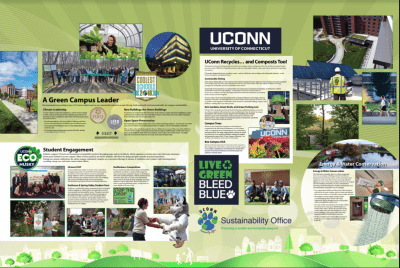
Learn more about our history in the infographic below!
What We’ve Learned

The development and growth of this position has led to many lessons on the potential successes in sustainability possible at a University campus, including:

  1. A senior level staff position reflects the University's commitment and sends a strong message to the campus community that environmental sustainability and compliance are core values of the institution
  2. A broad, multi-disciplinary organizational framework, such as UConn's environmental council, is necessary to achieve buy-in, develop consensus, and communicate with the broader community
  3. Student interns provide essential research and technical support services, particularly in the absence of full-time staff. Teamwork, and shared expertise and knowledge about how the university works are vital to the success of campus "greening" initiatives
  4. The campus setting, with its decentralized and diverse academic and staff departments, calls for a more flexible, consensus building and project approach to environmental management.
  5. Expect organizational change: Since the Director's appointment, UConn administration has been reorganized to separate the operational functions from the academic functions.
  6. Progress and change often occur slowly; not just because of the size and complexity of the university, but also the need to build environmental awareness, discuss issues, reach consensus, and implement programs that may be perceived as above and beyond the core functions (i.e. education and research).